Tuesday, July 11, 2017

Dry Creek In the Year of the Cat, Part I: For Now We're Going to Stay


Yesterday I knew exactly what I wanted to write for this post.  I was headed down an empty highway of this big, open valley, headed to work in a neighboring town on my day off to get a few things done, and I was listening to "Year of the Cat" by Al Stewart. 


Oh how I love that song.  I know the lyrics well, almost, but not quite, by heart.  When I was younger I was drawn to the escapism, the exoticness, and the romance of the song, crystalized in the first verse:

On a morning from a Bogart movie
In a country where they turn back time
You go strolling through the crowd like Peter Lorre
Contemplating a crime
She comes out of the sun in a silk dress running
Like a watercolor in the rain
Don't bother asking for explanations
She'll just tell you that she came
In the year of the cat


Anticipation is the teens and twenties.  A restless desire to be anywhere but the present.  Life is wide-open, full of potential.  The now sucks, but the future is open, there to be molded by fantasy, dreams and aspirations.  One morning happiness will just appear it seems.  The right woman to make everything right.  "She comes out of the sun in a silk dress running / Like a water color in the rain."  Wow!  Finally, at last.  Happiness:

She doesn't give you time for questions
As she locks up your arm in hers
And you follow 'till your sense of which direction
Completely disappears


That is youth, or at least mine.  Only a little of it was reality.  Most of it was my imagination.  But I did have a couple of weeks when a female friend from Germany came to visit while I was in college. We went on a long road trip from Dallas to Big Bend National Park and crossed the Rio Grande on a row boat to Boquillas, Mexico, spent the day strolling dusty calles and playing with the village children.  So there was a woman in a country where they turn back time.  I had my Year of the Cat.

Yesterday though, I was more focused on the final verse:

Well morning comes and you're still with her
And the bus and the tourists are gone
And you've thrown away your choice you've lost your ticket
So you have to stay on
But the drum-beat strains of the night remain
In the rhythm of the new-born day
You know sometime you're bound to leave her
But for now you're going to stay
In the year of the cat


Recently Marci and I decided we would have to leave Dry Creek.  The teaching positions we've been waiting for five years in this county of two people per square mile opened for others and not us.  It seemed it was finally time to leave this fantasy and move on to the city and reality.

Listening to "Year of the Cat" yesterday, I realized I have two loves:  Marci and Dry Creek.  As a child, I couldn't wait to get away from here, but from college on, I have been driven by the desire to return.  Because Dry Creek is in a rural area and employment is scarce, in a very real sense, it is in another land.  Children grow up, go off to college, get careers, and spend the rest of their lives trying to get back to this area.  For 13 years I taught in Arizona, spending nine months each year pining for my chance to return to Dry Creek each summer.

Finally, five years ago I decided to heck with it, I'm going to live the dream instead of simply measuring out my life in spoonful reality.  Without any jobs in place, we packed up and moved to this piece of paradise.  Although I didn't regret that decision--five years is five years after all--it seemed like the time was right to move on.

But in the process of letting the residential treatment center where I teach know I was looking for employment elsewhere, I was offered a healthy raise.  I discussed it with Marci.

Well morning comes and you're still with her
And the bus and the tourists are gone
And you've thrown away your choice you've lost your ticket
So you have to stay on.


Marci is my life, not Dry Creek.  I will follow her wherever she needs to go.  Yet, in a weird way, Dry Creek is the other woman.  She draws me, she dazzles me, she occupies my dreams and my time.  I guess my mom had to deal with the same thing.  My step dad was always outside spending time with this land, often only a block or two away, but away none the less lost in his secret connection with his other woman, this place--a daily wild, exotic escape from reality.

Life is uncertain.  To learn and grow we must free ourselves from the demands of the selfish "I".  We must be willing to let go, eventually, of everything except our connection to our creator.  So, I can't say we'll be here forever, but for now, we're going to stay

in the year of the cat.

 
The van stuck in the driveway Christmas time 2006 before our house was built. 
 
Mitchell helps grandpa burn at the bottom of "the big canyon".

My favorite maple grove on the property

Rio in the apricot tree

Rio and Everest with Grandpa at the front gate of Dry Creek

After Dad died, I erected this sign near the apricot trees he loved.

The line of cottonwood Lloyd and I planted along the road

A piece of old farm equipment that came with the property

Everest at Dry Creek

The first garden bed outback of our new house

Planting the first vegetables.

What led to building Marci's shade house.

It starts to come together.

Adding a fountain and dining

The front walk and grapevine

Marci feeds our new chickens.

A fine fall morning at Dry Creek

Fall snow on Mount Katherine

Winter at Dry Creek

Our dog Darth at Dry Creek.  She loved this place.

Building the grill pad out back.

The grill pad with its new deck.

Gravel for the eating area

The deck stained, the planters hung.

The grill pad complete
The main backyard path

Marci's cut-flower garden in the fall

 
Grapes ripening in the Hanging Bucket Garden


The new swing in Marci's Shade House

Sunflower Station, step 1


Sunflower Station, step 2


Sunflower Station, step 3


Sunflower Station, step 4

Sunflower Station, step 5
The work and escape continues

Tuesday, January 24, 2017

A Winter Walk at Dry Creek: Reacquainting Myself with Myself and the Land

Headed home from work on a chilly winter's day, listening to NPR and feeling blue.  A fragment in my life I didn't like.  It was nothing big; I just realized that I'm just enough in touch with the world to be out of touch with myself.  Yesterday, I'd spent way too much time on Facebook reading and commenting on political links.  All the peaceful protests give me hope, but there is something about social media that is spiritually deadening.  I have no intention of giving it up.  I have a couple of good friends who I really never knew outside the cyber world.  Facebook has also reconnected me with my two best friends from high school, who I'd semi-lost contact with before Facebook entered my life.  So, it's not that I think it's evil; it just distracts from living in the moment.

Even when I was a fairly unhappy person as a teenager and college student, I was always good at living in the moment.  Cafes, restaurants and bars became almost sacred places.  I spent hours silently reading while listening to casual conversations, the hum of heaters or overhead fans, and the occasional drop of ice in the ice machine.  I might have been alone and without belief, but I was grounded deeply to the now, and that felt good, if only for the moment.

I've lost some of that, and I want it back again.  Right now I hear bacon sizzling in the pan and smell that rich, sweet meaty aroma as Marci cooks us breakfast for dinner.

Anyway, on the way home, I glanced out my window down a long, straight, snow-covered farm lane edged by a barbed wire fence and elms.  When I saw it, that old, familiar yearning came back, and I thought to myself I've lost track of why I'm here.   Politics do matter.  It's important to speak out against Trump, not because any single action is effective, but because numbers matter.  Apathy and silence is democracy's greatest enemy.  But that's not why I'm here.  I'm at this place and time because of Dry Creek, because of my land, because of my heritage, because I've been a part of this place for so long that it is part of me.

As I neared our property and saw Harold, our resident eagle in his tree, I decided that I needed to take a walk.

Harold, our resident eagle, photographed in 2016 by Rio Brown

Everest decided to come with me, and so we also took the dogs.  We didn't go far--just up to my mom's house--but it was enough to reacquaint myself with the land, something I needed badly.  At least this day I found connection to the moment again. 

Looking down into the canyon from the old gate
Mt. Catherine (left), over 10,000 feet above sea level


Buddha (left), Oreo (behind), Everest, and Camilla (on Everest's lap)
rest on the bridge to Lloyd and my mom's house.


Friday, July 22, 2016

American Fecundity 2016

These are uncertain times.
Heat hangs heavy, unnatural,
skies cyclone-oppressive.
Hate thickens, alien-green.
The valley is still; not a blade
bends.   There is a highway out—
love actually
but all stand stoic, lulled
by the static dreadful
blossoming impossible.

 © Steve Brown 2016

Monday, July 18, 2016

True, Hard Fact: Repentance Requires Revision and Editing

Recently I’ve become acutely aware of what it means to be “born again.”  It’s not the free-ticket to redemption one might suppose.  We are promised by our Heavenly Father that if we repent, He will "remember [our] sins no more" (D & C 58:42).  I have no doubt that is true, for I have felt the joy that results from becoming worthy.  I have had the spirit testify that I have been forgiven, and I don’t carry around the baggage of my past decisions.  If my Heavenly Father has forgiven me, there is no reason why I shouldn’t forgive myself.  The redemption of Christ is about moving forward and not backwards.  He tells the woman caught in adultery that she is forgiven and “to go and sin no more”  (John 8:11). 

At first this sounds great, which it is--oh so much better than actually having to atone for ones actions alone without Christ to take on most of that burden.  Yet, truly being “born again” is not as easy as it sounds.  It requires extreme sacrifice.  It requires going through a veil, of giving up the old self, and allowing faith to create something new.   After all, if my Heavenly Father is to remember my sins no more, I must do the same.  That is hard stuff because that is my life wrapped up with my sins.   No matter how much pain and sorrow my old life brought me, no matter how heavy the void that hung around my neck, it was still my life, and there were good times mixed in with the misery.

I teach English at a residential treatment center for boys, and I saw one of my students struggle with this.  In his former life he was a street graffiti artist and small time dope dealer.  While at our school, he converted to The Church of Jesus Christ of Latter Day Saints and had slowly rebuilt his life based on gospel principles.  He was at a relatively safe place when he wrote a descriptive essay for me about his former life as a graffiti artist.  It was an amazing piece, describing the city in the early dawn and the peace and solitude he felt tagging right before the city awakened.  As writing, it was good stuff.  Had he been a shop owner washing down the sidewalk before opening shop it would simply be a pleasant memory.  But this moment of connection for him, because the life choices he had made, was attached instead to an illegal act and a former lifestyle that brought more pain than peace.  Yet, as the memory was pleasant, I could see it pulling him back to a life he needed to let go.

When he turned in the essay, I had two thoughts: 1) this is solid writing and 2) if I don’t help him, this boy is in danger of returning to a life of misery.  Because of my past, I knew I had to be honest.  Warnings about “Don’t go there” would only make him resentful.  After all, it was his life, not mine. What right did I have to tell him that the peace he felt that day was a lie?  I didn’t have that right at all.  And I knew that peace myself.  For me, it was city lights reflected at the bottom of the concrete channel of the Rio Grande from the Santa Fe Bridge between Juarez, Mexico and El Paso, Texas after a heavy night of drinking.  My life was miserable because of my choices but that stopping point on a bridge between two countries was none-the-less moving.  I still see that glassy, slightly rippled water, hard and slick as wet obsidian through the diagonal grid of the chain-link fence.

So, instead of lecturing him, I talked about giving up good things for better things.  He had lots of support from staff and has since married in the temple.  He chose to move forward not backwards.  But, I know that choice wasn’t easy. 

Here is the warning I give my children and future grandchildren:  Live your life so that you never have to “go and sin no more.”  Christ does provide us with fresh starts, but every time we have to be “born again” to move forward in happiness, we have to leave part of us behind.  Life is messy and good times get mixed in with our poor choices.  To truly start over, we have to leave the past behind.   In leaving the past behind, we leave a chunk of ourselves with it.

Live so that all your greatest memories can apply to the life you want to end with.  How grand it must be to be eighty years old, look back at your life and remember that your first night of intimacy was with your wife who is pushing your wheel chair when you are eighty.  Does that mean you can’t have a meaningful marriage if you had premarital sex with another woman or went through a divorce?  Of course not, a loving Heavenly Father does allow us to start over.  But not even the grace of God can unify a narrative that happened chaotically, without a plan.

True, one learns from mistakes.  One learns wisdom and empathy.  But learning is part of life.  You’ll gain wisdom regardless of your path.  Yet only one path leads to a life where all memories can remain in the narrative that ends with a resolution of joy not disjointed by sin.  It’s good to be able to say, “I was lost, now I’m found”; it is profound to be able to look back on your life and not need to edit anything out to move forward.

I love my life, sin and all, and if I had to do it all over again, without any changes, I’d be fine with that because I know I’d end up here, at a place of faith and the resulting joy that comes from being worthy of receiving the Holy Ghost.  Yet, I have to live with the knowledge that I could have lived another narrative, one where I never stopped speaking to my Heavenly Father.  No matter what I accomplish in this life, no matter how much joy I feel, no matter how close I draw to my Heavenly Father, I know that other narrative is better.  It is a fact I have to live with.  If I could teach my children the ultimate lesson, it would be this:

Live the life God intends for you NOW so that you never have to edit out chunks of living to move forward.  Every hard, right decision becomes a permanent detail to move the narrative forward.  Every wavering is an error that will eventually have to be erased through the revision and editing process of the atonement before the narrative is right.  Those scraps, those dribbles of less-than-perfect text, at some point must be set aside to move forward.  Imagine what it must be like to be Christ—for every word, every deed to be worthy of including in your life story.  You can’t accomplish that, but get as close as you can, and you will be happy for the majority of the narrative, even in moments of sorrow and pain because the Holy Ghost provides a joy deeper, better rooted, and stronger than circumstance.

Wednesday, May 18, 2016

To Be or Not to Be


Today a student asked me,
“What’s a bard?”  I said, “a slice of bacon
placed on meat or game before
roasting.”

It’s true & if

you’ve explained you’re a poet
at a family reunion  
you know exactly
what I mean. 
 

©Steve Brown 2016


Thursday, April 28, 2016

Defining Spaces in Your Garden through Outdoor Rooms (Love Your Garden)


Hanging-bucket garden before the grape vine took off.

There is nothing I like better than a vast, open, undisturbed prairie.  The back of our home at Dry Creek opens onto a large, open space that was once an alfalfa field, which I would like to turn into a prairie.  However, although prairies can actually benefit from temporary, seasonal stampeding, constant foot traffic and wild grasslands do not mix.    There was also the issue of shade.

What slowly evolved in my mind is a series of outdoor rooms, that would be very structured and geometrical next to the house and then would loosen up away from the house, slowly blending into the field beyond.  These rooms would not only provide shade, but they would also enclose areas enough to discourage deer, who we love, but who also provide challenges to gardening March through May and again in September through November.

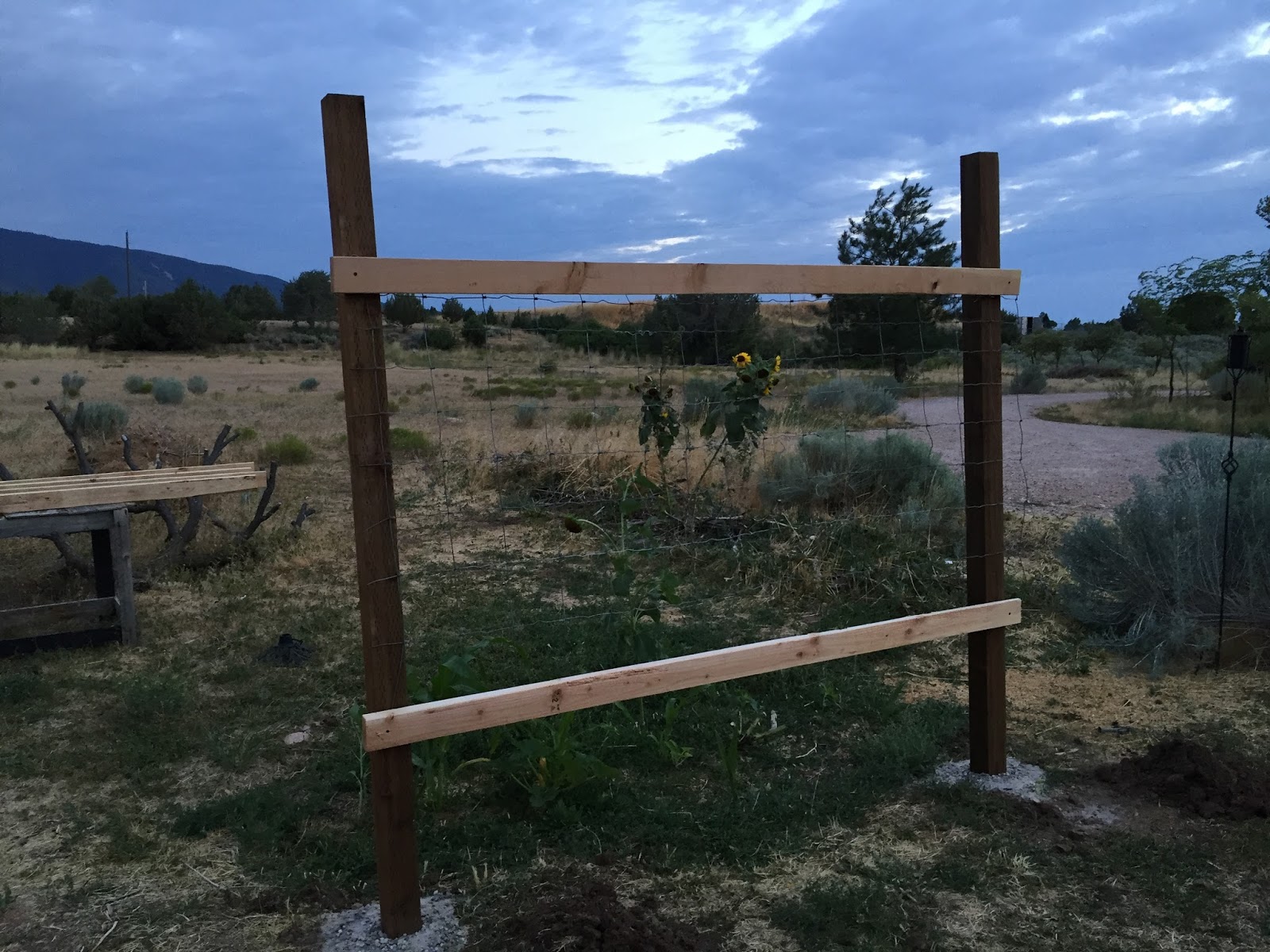
The first structure I built was my hanging-bucket garden (pictured above and below).  I built it as a wall to block the hot, late afternoon sun from the eating area.  It also provided a place I could plant flowers in the early spring when there are still too many deer to plant flowers on the ground.  The patio table on the east discouraged deer from that side.  To discourage deer from the west, I made a little room with a wrought iron fence (pictured above).  Although deer can easily jump fences over six feet tall, they are leery of tight spaces, so although not full-proof, it is a deterrent.

To blend in with the rustic surroundings, I used old juniper poles and some old window frames my brother-in-law gave me.  To increase shade, I planted a grapevine, which now covers most of the log rail structure and planted tall flowers, such as giant sunflowers inside the small garden created by the white wrought iron fence.

Close-up of repurposed windows in the hanging-bucket garden

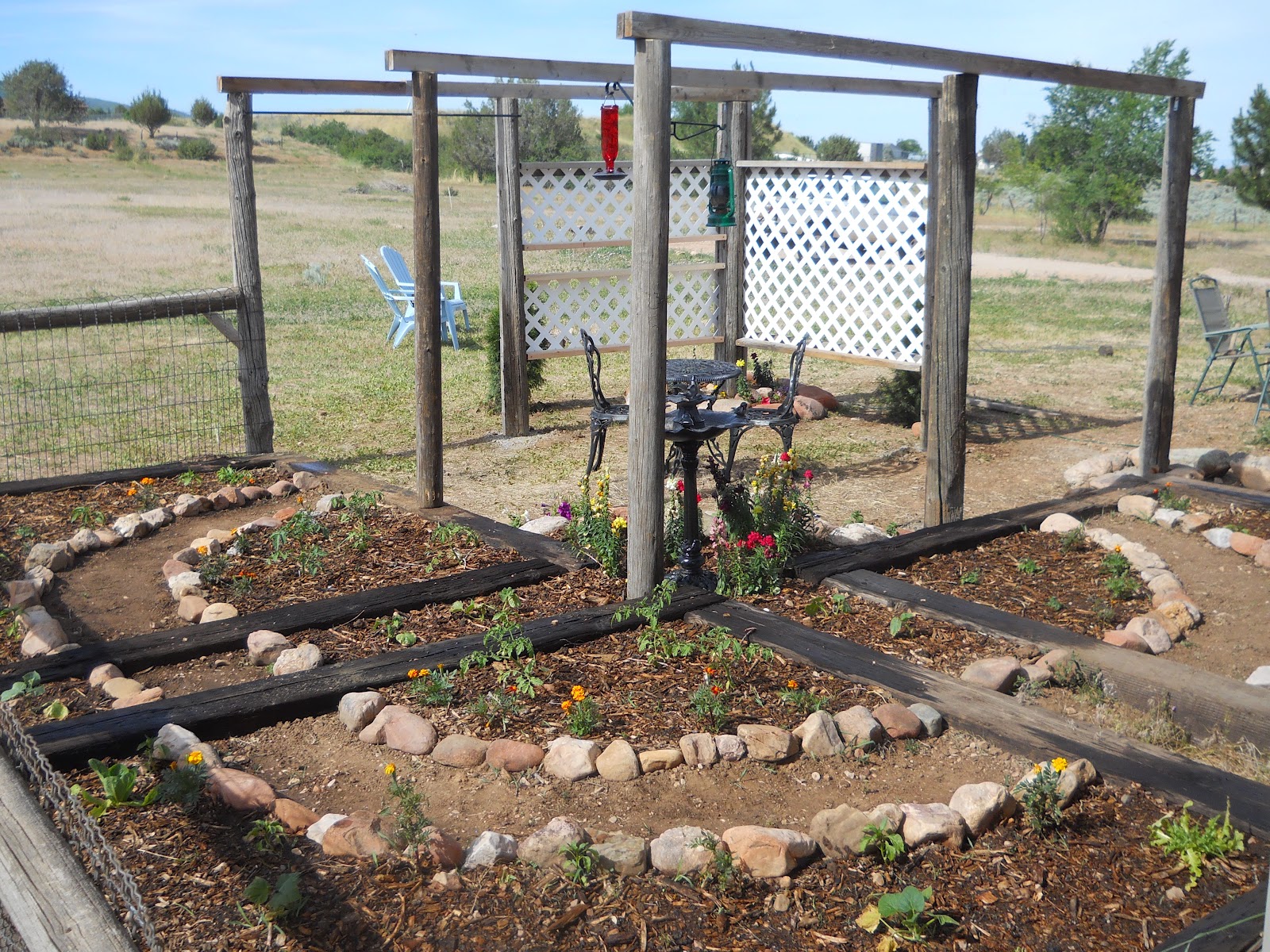
Next, I set about creating our vegetable garden.  At first I was just going to create a fenced in garden of four beds created by railroad ties, but in the process, I decided leave out the fourth bed and instead include a Pergola (pictured below) as a birthday present for Marci.  To visually tie the beds together, I created a circular path through the garden using gathered stones.


Vegetable garden and pergola under construction
 
To provide shade for the pergola, I ran wire fencing across the top, wove in some bamboo stalks, and covered it willow.  I also planted a grapevine that will eventually cover it.  The shaded space creates a cool outdoor room that looks out on the vegetable garden (pictured below).
 
Interior of the pergola and wrap-around vegetable garden

Next, I built a structure for my grill (pictured below) to keep it out of the weather and provide shade while I'm grilling.  It also created shade in the late afternoon for a second dining area. 

Newly completed grill pad

 
Next came the job of tying the areas together, which I'm still in the process of doing.  One such "hallway" is pictured below.
 
"Hallway" to the west dining area

The final trick is to have the spaces slowly loosen as you move away from the house.  So, you start inside the house, move out to outdoor rooms, move out to semi-formal gardens (more organic shapes, but still very defined spaces), which then slowly dissolve into nature.  I'm still in the process of this.  I used thuja junipers in pots to provide structure along the main garden path.  Native rabbit brush fit well with the Tuscan feel of the garden. 

Potted thuja junipers soften garden structures
 
Starting to get that Tuscan garden feel
 
Although I haven't directly drawn ideas from the show, I absorb much of my inspiration from watching Love Your GardenAlan Titchmarsh and his gang have a real sense of gardens as composed spaces.  Below is a short clip of one such garden.  Enjoy.


Monday, April 4, 2016

Stones: the Weight of Liberation (Neil Diamond's "I Am I Said," Bono's "Yahweh," and Bill Flanagan's Stupidity)

Somehow not even Bono can make it artistically kosher to love Neil Diamond.  I'm not sure how that happened. Diamond was once a respected songwriter whose music was covered by the Monkeys, Deep Purple, Elvis and UB40.  True, he did write one incredibly stupid hit about that little alien who wants to phone home.  But, come-on, he's not the only one whose sentimental heart lit up when that insipid green munchkin rode a bike across the silver screen.  Besides, we've forgiven Elton John for "Don't Go Breaking My Heart" and Paul McCartney for "Ebony and Ivory."  Why doesn't the artistic atonement apply to Neil Diamond?  Why, despite all of his good works, is he cut off from grace because of one or two lousy mistakes?

Stones is an amazing album.  Perhaps one of the best.  Like the Beatles white album or Fleetwood Mac's Tusk, even the cover is art.  My copy, handed down from my mother who purchased it in 1971, has a subdued canvas colored background with a course linen fiber printed on it.  In the middle of it is a photograph of Neil Diamond sitting on a park bench in front of a massive stone Italian-styled garden wall.   An old and twisted tree stands in the right hand corner; a stone bust sits in a niche in the wall just left of center, just to right of Diamond, who sits stoically arms folded, his stone face looking out at the audience with no expression.  He is barefoot, which with his stoic look and the old-world setting, gives his form the feel of a statue, adding to the crumbling, classical feel of the mostly monotone photograph of gray and olive. The cover reminds me slightly of Led Zeppelin's "Stairway to Heaven" album with the crumbling wall and portrait of the old man.  There is the same heaviness about it.


The entire album is worth listening to, but I'll focus on side two.  I believe this one side of vinyl contains some of the greatest lyrics ever written, although Neil Diamond only wrote two of the songs.  I don't think that is a coincidence.  Like Elton John's Blue Moves, this album is, in part, a reflective evaluation of the cost of fame. Elton John dealt with that by returning to his classical, jazz and blues roots.  Perhaps, Diamond's decision to use other people's material is a reaching out to the void, hoping for an answer more significant than his own name.  "I Am, I Said," his own song, definitely demonstrates the desire to be grounded in significance.

First, we have the title track, "Stones," one of Diamond's own:


The song starts with a simple strum of the guitar, and then enters the line "Stones would play inside her head," a startling image of uncomfortable weight and solidity oddly placed within the mind.  He follows this up with the image of her bed being made of stones--no peace of mind and no rest for the body due to a solid mass that must be dealt with.

But, it's not a mass without meaning.  We are not shoved into the nihilism of Hemingway here.  This is not a world of nada y pues nada.  The stones may be uncomfortable; they may be there to be dealt with; but they also provide shelter and shade for new beginnings:

You and me, a time for planting
You and me, a harvest granting
The every prayer ever prayed
For just two wild flowers that grow

on stones.

There is beauty here, but it isn't an easy beauty.  It's more like the beauty the atonement brings, a grace that comes after the old has been broken down and something new takes root in the rubble.

This contrast of dark and light, of the jeweled flower among the rock, continues in the second song, "If You Go Away" written by Jacques Brel and Rod McKuen.


And then there's "Suzanne."  Ah "Suzanne," what to say?... Leonard Cohen's lyrical masterpiece, but Diamond brings a weight to song that Cohen just wasn't able to do.


The song starts in the sensual world of materialism:

Suzanne takes you down to her place near the river
You can hear the boats go by, you can spend the night forever
And you know that she's half-crazy but that's why you want to be there
And she feeds you tea and oranges that come all the way from China

Cohen concludes the first third of the song with "For you've touched her perfect body with your mind."  Then, the song pivots from sensual world of light and aroma to the weighty divine:

And Jesus was a sailor when he walked upon the water
And he spent a long time watching from his lonely wooden tower
And when he knew for certain only drowning men could see him
He said all men will be sailors then until the sea shall free them
But he himself was broken, long before the sky would open
Forsaken, almost human, he sank beneath your wisdom like a stone.


Next, comes Randy Newman's composition, "I Think It's Going to Rain Today," which also swings on a fulcrum.  The first half of the song describes interior bleakness:

Broken windows and empty hallways
A pale dead moon in the sky streaked with gray
Human kindness is overflowing
And I think it's going to rain today.

Here, "Human kindness is overflowing" is sarcasm, as indicated by both the music accompaniment and the lines that follow:

Lonely, lonely
Tin can at my feet
Think I'll kick it down the street
That's the way to treat a friend


Human kindness is not overflowing.

Then comes the pivot.  The music changes, becomes upbeat, and similar words take on new meaning:

Bright before me the signs implore me
To help the needy and show them the way
Human kindness is overflowing
And I think it's going to rain today.


Here, it's not the weather that will rain, but the human kindness that is overflowing, love filling the cup up to the brim and raining down on humanity.

Notice the repletion of imagery and themes here.  "Stones" starts with the hard imagery of rocks, but ends by noting that the stones provide shelter for "two wildflowers that grow."  "Suzanne" echoes the flower imagery:  "And she shows you where to look /Among the garbage and the flowers," here garbage providing shelter for the flowers.   "Suzanne" also repeats the imagery of stone in, "he sank beneath your wisdom like a stone"Here, that weight is ambiguous, depending on how you read the lyrics.  The line could mean, his wisdom sank unnoticed by those that executed Him.  Or, as the "you" in the song seems to refer to the speaker, as we don't all know a "Suzanne," it can also mean his that His presence sank deep into the speaker's soul with great redeeming weight, which is how I read it.

Although Diamond is Jewish, I would argue that in purposefully selecting the songs he has chosen, Diamond is setting up Christ as a symbol for human redemption, which is carried to its climax in "I Am, I Said."


Diamond begins by comparing his new home of L.A. with his roots in New York, saying that he feels "lost between two shores."  Although this is clearly biographical and must be taken literally, I will argue that he extends the literal image out into a metaphor for the human predicament.  We are all lost between two shores.  We are here in this temporal world, "among the garbage and flowers" as noted in "Suzanne," but we also have a divine, spiritual origin that deep down we can't forget, which leaves us feeling lost, ghostlike, unreal, like Christ, "almost human" and yet "almost divine," "lost between two shores."

And so we cry out--not to other men--but to the void, the divine, the spark that brought us into being because the "emptiness deep inside" calls us back to our true home, that distant memory before we were here.

In U2 at the End of the World, Bill Flanagan makes light of Bono's claim that Neil Diamond is a serious song writer. 

Bono looked down his nose at my sarcasm and asked, "Do you know what 'I Am, I Said' is all about?

Flanagan spews out the surface meaning with the depth of understanding of a Pharisee, giving the literal background which inspired Diamond to write the song with little awareness that poetry gains weight as it is written that moves it beyond the initial impulse in scope.

Bono, not flinching, asserts, "God is described as the great I am.  So, in that song Diamond is calling out to Jehovah.  'I am, I said," means, 'God, I said.'  To who?  To no one there!  And no one heard at all, not even chair!  Do you see?  It is a song of despair and lost faith by a man calling out to a God who isn't interested!"

I agree.  Well, mostly.  If you take only "I Am, I Said" by itself  that is true.  It is Christ calling out, "My God, my God, why hast thou forsaken me?" before being transformed.  But, taking in all of Stones it is the calling out to God in pain the moment before rebirth.

It matters not that Diamond is Jewish.  Poets borrow metaphors all the time.  Christian poets tapped into Greek mythology for centuries.  Besides Jews do believe in Christ--they just don't believe he has already been born and died; but the idea of rebirth out of hardship is nothing new to them. 

In "Yahweh," Bono puts it this way:

Take this shirt
Polyester white trash made in nowhere
Take this shirt
And make it clean, clean
Take this soul
Stranded in some skin and bones
Take this soul
And make it sing, sing


Yahweh, Yahweh
Always pain before a child is born
Yahweh, Yahweh
Still, I'm waiting for the dawn


It is almost as if Bono said to himself, alright the critics won't take "I Am, I Said," seriously because they won't take Neil Diamond seriously, I'll show them.  I'll write my own "I Am, I Said," and they will take that seriously because "I Am Bono."

Of course I don't really think Bill Flanagan is an idiot.   I think his U2 at the End of the World is a fine book.  But, Flannigan is just one among many who for some bizarre reason are out to stone one of our finest song writers, Neil Diamond.  Perhaps some day he will see the errors of ways and tap into the beauty of Stones.  There is certainly sustenance there for those willing to listen.