Showing posts with label permaculture. Show all posts

Tuesday, March 17, 2015

Lessons in Sustainable Living from the Grapes of Wrath, Chapter 5: A Reading and Writing Journal (Entry 3: Start Small; At First, Make Your Money Elsewhere; Grow Soil, Not Crops)

The vegetable garden pergola at Dry Creek--a great place to read.

Analysis: 

Steinbeck begins with the concrete:

The owners of the land came onto the land, or more often a spokesman for the owners came.  They came in closed cars, and they felt the dry earth with their fingers, and sometimes drove big augers into the ground for soil tests.  The tenants, from their sun-beaten dooryards, watched uneasily when the closed cars drove along the fields.  And at last the owner men drove into the dooryards and sat in their cars to talk out of windows.  The tenant men stood beside the cars for a while, and then squatted on their hams and found sticks with which to mark the dust.

In The Grapes of Wrath, it is the camera-like eye that tells the truth.  The humans, on all sides, are just trying to figure it all out.  There is a clear moral center, but it doesn't come from the people.  It comes from the omnipotent eye.  That's why the nonfiction-like chapters sandwiched between narrative chapters are essential to the book.  Although lessons in sustainable living continue consistently though out all the book, they are most apparent in the in-between chapters, where, in a sense, the eye-of-God, becomes the narrator.

For instance, in the short paragraph above, we see a couple of malignant factors innate to the economic system:

1.  The owners of the land do not work the land, and therefore have no relationship with it.  Usually, they do not even bother to come look for themselves, but send employees.

2.  Those that work the land don't own the land.  Even if we disregard economic justice here, the eye shines brightly on the unsustainable nature of tenant farming:  those who work the land, know the land, understand the land, depend on the land, ultimately have no influence over the land, because they don't own it.  Their economic status, as we will see, forces them to plant whatever crop pays the most or they are in danger of losing it. 

But God's eye doesn't villain-ize either the owners or their representatives.  The eye remains objective.

Some of the owner men were kind because they hated what they had to do, and some of them were angry because they hated to be cruel, and some of them were cold because they had long ago found that one could not be an owner unless one were cold.  All of them were caught in something larger than themselves.

But it doesn't ignore the evil inherent in the system either:  

The owner men went on leading to their point:  You know the land's getting poorer.  You know what cotton does to the land; robs it, sucks all the blood out of it.

The squatters nodded--they knew, God knew.  If they could only rotate crops they might pump blood back into the land.

But they can't make that choice because the banks own the land and the banks must be paid.  Cotton pays, so the land is robbed, year after year, in order that the corporations survive.

The corporation, or mammon, is the center things, not the earth, not nature, not creation, and so in a very real way, even though the individuals may be good, the system is an abomination.

Lessons Learned:


1.  Start small.  If all you have is the 1/4 acre lot your house in the suburbs sits on, farm it well.  Pay off your loans quickly.  As long as you have a mortgage on your land, it isn't yours.  If you lose it, you will no longer have any say about what becomes of it.


2.  At least in the initial stages, make your money elsewhere.  That way all your decisions can be based on what's best for the land in the long term.  You won't have to compromise in order to make enough money to get through the year.  If you do begin to profit, grow slowly, and make sure the amount you live off is less than what it takes to sustain your land. 

3.  Grow soil, not crops.  Once the soil is healthy, the garden almost takes care of itself.


Friday, March 13, 2015

Dry Creek from Above: Phase 1--The Five-Year Master Plan (Garden Design, Water-wise Landscaping, Hugelkultur)


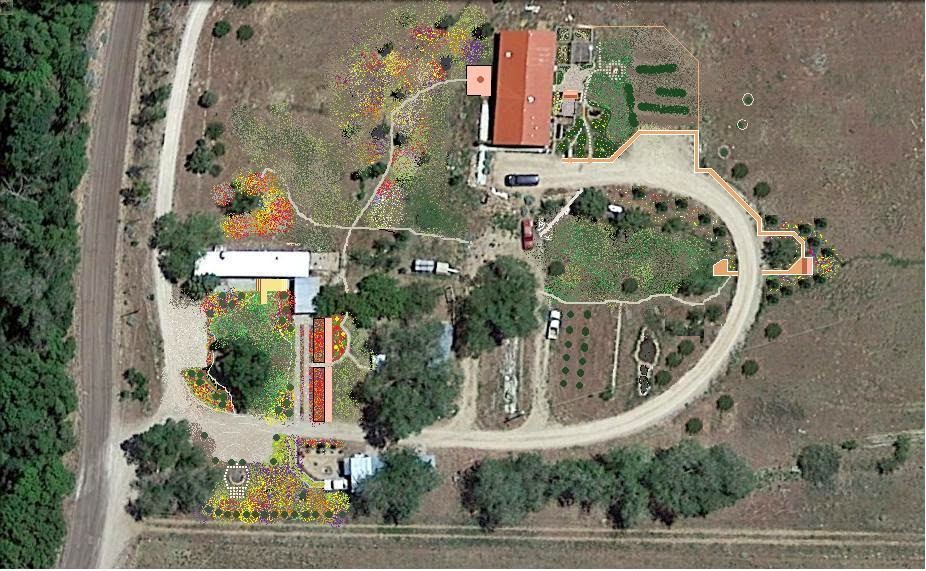
Picture this:  You are heading up a narrow, paved road towards the mountains; on the left is a thick wall of oak and maple clinging to the shaded slopes of a canyon that drops off to the cottonwood bottoms below.  In front, and to the right, is a farm with big, old elms, a trailer house, various out buildings.  But as you turn onto the gravel lane, a world of color opens up. The typical western barnyard blossoms into a playful mix of Tuscany, 1940's and 50's Americana, the psychedelic 60's, and a little bit of Mexico.  This is Dry Creek Farm--where the whimsical is woven with the past and nature to create an interplay of texture, color and spaces.  

Okay, so I dream.  But they are not totally idle dreams.  And I'm not sure they are unattainable.  I have accomplished quite a bit in two years.   


First, an overview of the western 30 acres of Dry Creek.  The photo above shows the portion of the property nearest town.  The top of the photo faces west.  The big, square pond is the county irrigation pond.  The dirt road near the top that goes from the black top to the county pond is the border of the property.  The red-roofed house is ours.  The small pond near the center is where we swim.  The thick band of trees near the bottom of the photo is Dry Creek Canyon, an oak and maple forest watered by a seasonal creek.  Mom and Lloyd's house is at the end of the long gravel road, near the pond.  The pond to the left is actually not on our property, but we have access to it, due to the fact we share irrigation.  When there is water (March through early July), there's lots of irrigation, but sometime between July 4 and July 15th, everything dries up.  This makes our property great for growing trees, but not much else--at least not with traditional farming techniques.  We once grew alfalfa, but we were only able to harvest two crops per year.


Above is a picture of the portion of our land that I consider my yard.  The top of the picture faces east.  It is here, I'll begin developing the gardens.  The thick band of trees left of the road is Chalk Creek Canyon.  When I was a child, the creek here flowed year-around.  However, the county now sucks it dry up-stream most of the year and sends the water to the county irrigation pond.  So here, Chalk Creek has become a seasonal stream, like Dry Creek.  

Just right of the road is the trailer, which for years was our summer home.  To the right of that is the "pig shed," the last of the farm that existed when I was a child.  It is hard to see, being under a canopy of trees.  Across the gravel road, near the bottom of the picture, is the "Blue Door Bar," an old shed we converted into a TV room when we spent our summers in the trailer.  To the east of the trailer and north of the house are the 25 oaks Lloyd and I planted as bare-root saplings back in 1996.  It's taken a long time, but they've become fairly impressive, and will really be amazing in another 10 years.  


Above is the master plan for the gardens at Dry Creek.  After you enter past the elms at the bottom left-hand corner, there will be a choice of two parking areas, one by the trailer, and one near the western fence line.  Generally, I'm against lawn because of the water it uses. However, as the lawn in front of the trailer is part of the land's history, I'd like to keep part of it, at least for a while.  Yet, it is very difficult to keep it green, especially around the edges. Therefore, I'd like to cut it back in an irregular shape and create metaphorical pond.  I'll put boulders around the edge, along with alpine flowers and aspen.  I'm also going to extend the trailer porch out into the green of the lawn as a dock and tie a canoe to it.

Because lawns are well-watered, Aspen eventually send out succors, and if not mowed regularly, take over.  Not only am I fine with that, it is part of the plan.  As much water as aspen need, lawn needs a whole lot more.  Last summer, I watered my lawn on average of three times a week and for most of the summer, it was a pale, dusty green with yellow brown around the edges.  In contrast, I watered my aspen groves on average, once every two weeks.  And I'd rather have an aspen forest than a lawn anyway.  The lawn-lake just creates a fun metaphor to enjoy until the aspen take over.

West of the other planned parking lot is an old cattle trough, which I'll turn into a fountain.  There will be a formal stepping stone path around it, and a small patio behind it with a wrought iron cafe table and two chairs.   Surrounding this will be a Tuscan-styled garden, framed at the back with skyrocket juniper.  I'll also place skyrocket juniper around the parking lots, that'll frame the garden like the scattered ruins of Roman columns.   For vegetation, I'll plant drought resistant plants and flowers, like lavender, black-eyed Susans and sunflowers.  As this garden is a ways from the house, it would be best if it can look healthy with only one watering per week. Using the soil building methods of permaculture, this should not be that hard to accomplish.

Next to the Tuscan-styled garden is the existing rose-garden and the old Mercedes I painted to go with the Blue Door Bar.  Here, I want to plant a dirt road in front of it.  I did say that right.  I'll use flowers to create the illusion of a dirt road with the two tire tracks and with a grass center. Only it will be created completely out of flowers.


An old Mercedes my in-laws were nice enough to haul 242 miles on the back of a trailer
so that I could decorate my property with it.  I added the yellow.
The Blue Door Bar, an old shed we converted into a family TV room and hang out.

To the south of the trailer, in the "square," which is framed by three big, old apricot trees to the east and the pig shed to the south, will be four whimsical specialty gardens, which Marci has made me promise to keep secret until they're completed.  She believes the gardens are unique enough someone might steal the idea.  She might be right,  so I'll share those when they're complete.  


The winding trail that begins in the Specialty Gardens will connect the gardens at the front of the trailer with the oak forest Lloyd and I planted back in 1996 and Marci's cutting flower garden.  As we enjoyed Marci's cutting flower garden so much, we decided we will expand it into the the oaks.  So, we'll have cosmos, bachelor's buttons, zinnias, wildflowers and sun flowers growing in a among the trees. 15 minutes of water per day was more than enough to keep them thriving, and that was without much mulching or building up of top soil.  Using chop and drop methods, I'm sure it won't take too many years before watering can be reduced to 15 minutes, three times a week.  


Marci's Cutting-Flower Garden 2014 with the Oaks and House Behind

Shortly after crossing through the old apricot trees and past the aspen grove, there will be another trail heading south, which heads into the big "island" which is formed by our driveway. This is part of the old barnyard, and the soil is very good here.   On the left side of the trail will be a large park area covered in buffalo grass.  This is so the grand kids will have a place to kick a ball around or play tag.  To the right will be the fruit orchard, a small pond and a pine and aspen forest.  The trail will end at wooden deck that looks over a small winding irrigation stream.


Park Area for the grandchildren.  Currently it is seasonal cheatgrass that I mow.
I'll plant buffalo grass here because it doesn't take too much water, and yet stays soft.


The small reflection pond.  It needs to be lined properly.

The deck will be connected to the driveway by a boardwalk, which will then will continue on the other side of the road and lead to a shaded wildlife overlook platform surrounded by aspen and a large Austrian pine.  There is also an irrigation ditch here to overlook.

The Wildlife Overlook Platform will be designed
to match this grill pad, unifying the garden.

The boardwalk will then continue around the opposite side of the pine, where it will follow the road around to another parking area and our backyard, where our vegetable garden is. Featured here will be three large hugelkultur mounds.  


I hope the above plan gives some idea of what the finished garden will look like.  I believe it will be stunningly beautiful, and more importantly, for its size, will only use moderate amounts of water--far less water than the alfalfa field did.


Sunday, October 12, 2014

Fall Reflection: If your garden is working you during the summer, you are doing something wrong (soil building and chop and drop).

Fall Colors near Mud Puddle, about 5 miles from Dry Creek
Fall is here, as is a cold front.  Low, heavy clouds hang along Sandrock Ridge, White Pine Peak poking his head above them.  Below the clouds, most everything is burnt sienna, with blotches of gold and crimson red.  We had a wet July and August, and the trees are extra vibrant.  So much so, even while dealing with the pain of this infection, I forced myself to get out and see the colors closer than from the sliding-glass door.  Even as close as Dry Creek Canyon is to the house, I had to drive over and take photos from inside the car, but it was worth it.  I also drove up an area known as Mud Puddle, a low, wet saddle filled with Maple, about five miles from here.

Fall colors at Dry Creek, about 200 feet from the house
It takes a while to re-acquaint yourself with a region.  Although we’ve always spent our summers here at Dry Creek, it was our vacation home.  I did plant a few flowers during those breaks, had trees on drip, and kept a nice lawn, but I never got to know the earth again as I did as a child.  It’s hard to explain, but there is a difference between seeing a place and knowing a place.  After you stay put for a while, it’s as if there is some sort of spiritual exchange, where you become part of the place and the place becomes part of you.  You grow into each other.  It’s sad, for so many, career paths have replaced that connection.  Hardly anyone is from anywhere these days.  I don’t think that is meant to be.  For thousands of years local has been a definition of who we are.  True, migration always took place—Europeans uprooted themselves and came to America, east-coasters moved west, but those events took place once or twice in a lifetime, not every three to four years. Even migrant cultures, like the plains Indians, had a territory that they walked and rode seasonally.  Anyway, this is first summer since we moved back where I really felt grounded.  Part of that has to do with finding steady employment that meets our basic financial needs, but most of it just has to do with being here long enough to reacquaint myself with the land.

In fact, I’ve become so grounded, I hardly even leave my garden except to go to work.  I use to spend quite a bit of time on the ATV, riding up the canyon to see the creek, cottonwood, willow and foothills.  Once I got my fish pond and borders in out back, there seemed little reason to venture beyond the back yard, other than to water Marci’s cutting flowers over by the trailer, and to feed the chickens.


This small pond attracts dragon flies, bees, wild turkey, coyotes--and maybe even a mountain lion.


Marci's cutting-flower garden with our house in the background
Everything I needed to enjoy life was right outside the sliding glass doors.  The pond drew dragonflies, bees, wasps ,and wild turkey during the day, and at night coyotes.  I had humming birds, butterflies and tarantulas.  Every day something new had died and gone to seed, and something new was blooming in its place.  It was like watching the show Nature—only live and up close.
Flowers in the vegetable garden--food and color grow well together
That was up until late-July.  Then, the pain from this infection made even my garden out of reach.  Rio and Marci took over most of the watering.  Then, I watched from my recliner.  It wasn’t quite the same.  I could no longer watch the dragon flies hover above the pond—my favorite activity.   But, I could still watch the ever-changing tapestry of color, notice how a sun flower is peaking in the kitchen window, now almost the whole window is a picture of golden blooms, and now—dang they are so tall, the blooms are above the sight of the window!
Jack drinks from a saucer in the garden--even after a summer of no care, the garden has charm.
Yesterday was the first time I’ve really been able to spend any time in my garden in over a month.  Other than watering, it hasn’t been cared for since mid-July: no weeding, no thinning, no pruning.  And it’s still beautiful!  If you plant seed and water, nature takes care of itself.  People who think gardening is too much work don’t know how to garden.  Only lawns enslave their masters.  Gladiolas, black-eyed-susans, marigolds, amaranth, sunflower, tomatoes, zucchini—they just grow!  All you have to do is watch humming birds and butterflies.  Sure, it’s nice to pull that morning glory that’s yanking down that clump of bachelor’s buttons, but it’s not necessary.  Even entangled and pulled askew, they still bloom magnificently.
Sunflowers retain their beauty even after going to seed.
The main thing to do is grow soil.  That’s why my garden was so stingy last year.  I didn’t have enough soil.  This year I did.  It takes a while to grow soil.  My challenge this fall is to get well enough to dump leaves, sticks and horse poop over the dry bones and wilted flesh of this year’s garden.  That, after all is the most important part of gardening.
As I learn more, I’m realizing that the work of gardening takes place in the late fall and early spring.  Summer is the time to kick back, watch and enjoy.  If your garden is working you during the summer, you are doing something wrong.
Enjoy these two videos on soil building, and begin building a soil today that will create a relatively work-free garden next summer.


Saturday, January 18, 2014

Permacuture: The Back to Eden Revolution and Paul Gautschi

Today I arrived home from work, tired as I often am after a long day of work and a forty-five minute commute.  I was also somewhat depressed.  Day after day of drought—still, cold inversion air on the valley floor holding in pollution, even here in this big, open rural valley, over seventy miles from the population of the Wasatch front.

But when I arrived in my drive, I found five doe and a buck.  My driveway circles in past the old barn yard and makes a big J ending at my house.  The deer were on the inside of that J and just watched as I drove by, circled around and got out of the car on the other-side of them.  They watched me carefully, just in case, but we have built a relationship.  During the deer hunt, they crowd right around my house, strip my grapevine between the house and front walk free of the last grapes and leaves.  This fall they even ate the pansies in a pot on my front porch.

I use to fight them, throw rocks and profanities at them, as they do love to pull up bulbs and strip the bark off trees.   Then last fall, I decided the most significant thing about Dry Creek is the abundance of deer and wild turkey.  Wildlife is what makes here here.

Of course, the deer are not going to leave if I toss rocks and swear at them.  But, they did use to run.  And I haven’t found any more damage to my plants since I decided to make friends.  All that has changed is that I’m angry less often and I can get a lot closer to them.  There also seem to be more buck.  I don’t know if that is because of my changed relationship or not, but I’d like to think so.

Permaculture, according to Bill Mollison, “is a philosophy of working with, rather than against nature; of protracted and thoughtful observation rather than protracted and thoughtless labor; and of looking at plants and animals in all their functions, rather than treating any area as a single product system."

Dry Creek belonged to the deer long before it ever belonged to my family.  Someday, I want a large botanical garden here of small, diverse ecosystems, mixing edibles with decorative plants in ways that are festive, whimsical and practical.  But however I do that, these designs will have to leave room for the turkey and the deer.  There is nothing I could add to this landscape that could compare with the deer.  They give meaning to here.

Pemaculture, which I’m just learning, like Buddhism, emphasizes stillness—learning from nature and implementing the same processes only at an excelled speed—rather than laboring against nature.  One of the first steps to understanding permaculture is to comprehend that the true roll of the gardener is grow soil.   If the soil is good, plants take care of themselves.  I’m in the preschool stages of this education and I spent way too much time watering last summer because I hadn’t mulched enough during the fall, but I’m learning.

“Grandpa’s Orchard” at Dry Creek last spring—Because this is part of the old barn yard and the natural composting that goes with that—scatterings of hay, straw, piles of dung, etc.—soil is good here.  The trick is to speed up that process over the rest of the property, where topsoil is shallow to nonexistent.

Enjoy this video of the “Back to Eden” farm and begin learning permaculture for yourself.


Paul Gautschi--He's a little outwardly closer to God than many of us are comfortable with, but he knows his stuff. If you want to know how to build soil, he's your new guru, no matter your crede.