Hanging-bucket garden before the grape vine took off.
There is nothing I like better than a vast, open, undisturbed prairie. The back of our home at Dry Creek opens onto a large, open space that was once an alfalfa field, which I would like to turn into a prairie. However, although prairies can actually benefit from temporary, seasonal stampeding, constant foot traffic and wild grasslands do not mix. There was also the issue of shade.
What slowly evolved in my mind is a series of outdoor rooms, that would be very structured and geometrical next to the house and then would loosen up away from the house, slowly blending into the field beyond. These rooms would not only provide shade, but they would also enclose areas enough to discourage deer, who we love, but who also provide challenges to gardening March through May and again in September through November.
The first structure I built was my hanging-bucket garden (pictured above and below). I built it as a wall to block the hot, late afternoon sun from the eating area. It also provided a place I could plant flowers in the early spring when there are still too many deer to plant flowers on the ground. The patio table on the east discouraged deer from that side. To discourage deer from the west, I made a little room with a wrought iron fence (pictured above). Although deer can easily jump fences over six feet tall, they are leery of tight spaces, so although not full-proof, it is a deterrent.
To blend in with the rustic surroundings, I used old juniper poles and some old window frames my brother-in-law gave me. To increase shade, I planted a grapevine, which now covers most of the log rail structure and planted tall flowers, such as giant sunflowers inside the small garden created by the white wrought iron fence.
Close-up of repurposed windows in the hanging-bucket garden
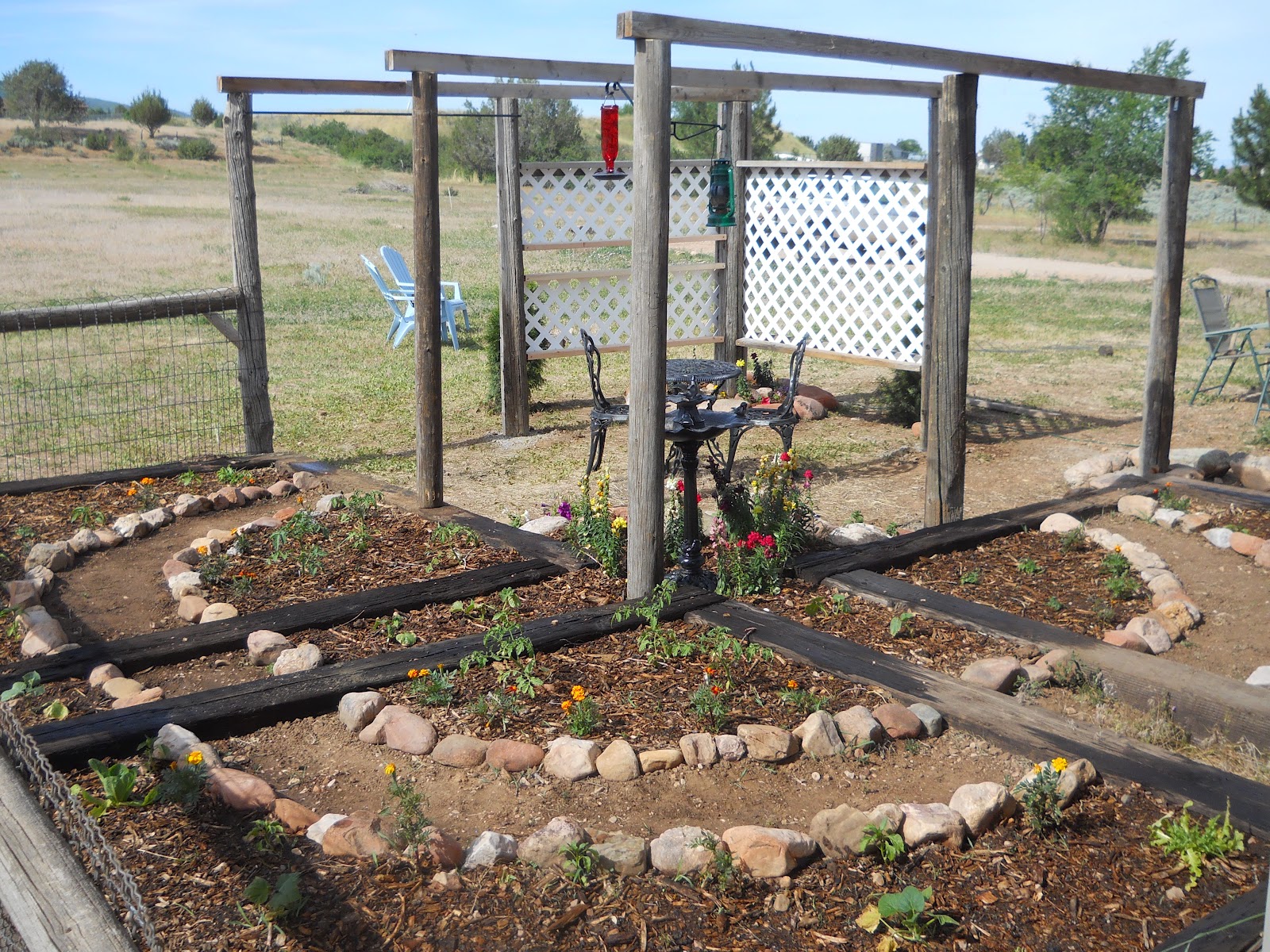
Next, I set about creating our vegetable garden. At first I was just going to create a fenced in garden of four beds created by railroad ties, but in the process, I decided leave out the fourth bed and instead include a Pergola (pictured below) as a birthday present for Marci. To visually tie the beds together, I created a circular path through the garden using gathered stones.
Vegetable garden and pergola under construction
To provide shade for the pergola, I ran wire fencing across the top, wove in some bamboo stalks, and covered it willow. I also planted a grapevine that will eventually cover it. The shaded space creates a cool outdoor room that looks out on the vegetable garden (pictured below).
Interior of the pergola and wrap-around vegetable garden
Next, I built a structure for my grill (pictured below) to keep it out of the weather and provide shade while I'm grilling. It also created shade in the late afternoon for a second dining area.
Newly completed grill pad
Next came the job of tying the areas together, which I'm still in the process of doing. One such "hallway" is pictured below.
"Hallway" to the west dining area
The final trick is to have the spaces slowly loosen as you move away from the house. So, you start inside the house, move out to outdoor rooms, move out to semi-formal gardens (more organic shapes, but still very defined spaces), which then slowly dissolve into nature. I'm still in the process of this. I used thuja junipers in pots to provide structure along the main garden path. Native rabbit brush fit well with the Tuscan feel of the garden.
Potted thuja junipers soften garden structures
Starting to get that Tuscan garden feel
Although I haven't directly drawn ideas from the show, I absorb much of my inspiration from watching Love Your Garden. Alan Titchmarsh and his gang have a real sense of gardens as composed spaces. Below is a short clip of one such garden. Enjoy.
Somehow not even Bono can make it artistically kosher to love Neil Diamond. I'm not sure how that happened. Diamond was once a respected songwriter whose music was covered by the Monkeys, Deep Purple, Elvis and UB40. True, he did write one incredibly stupid hit about that little alien who wants to phone home. But, come-on, he's not the only one whose sentimental heart lit up when that insipid green munchkin rode a bike across the silver screen. Besides, we've forgiven Elton John for "Don't Go Breaking My Heart" and Paul McCartney for "Ebony and Ivory." Why doesn't the artistic atonement apply to Neil Diamond? Why, despite all of his good works, is he cut off from grace because of one or two lousy mistakes?
Stones is an amazing album. Perhaps one of the best. Like the Beatles white album or Fleetwood Mac's Tusk, even the cover is art. My copy, handed down from my mother who purchased it in 1971, has a subdued canvas colored background with a course linen fiber printed on it. In the middle of it is a photograph of Neil Diamond sitting on a park bench in front of a massive stone Italian-styled garden wall. An old and twisted tree stands in the right hand corner; a stone bust sits in a niche in the wall just left of center, just to right of Diamond, who sits stoically arms folded, his stone face looking out at the audience with no expression. He is barefoot, which with his stoic look and the old-world setting, gives his form the feel of a statue, adding to the crumbling, classical feel of the mostly monotone photograph of gray and olive. The cover reminds me slightly of Led Zeppelin's "Stairway to Heaven" album with the crumbling wall and portrait of the old man. There is the same heaviness about it.
The entire album is worth listening to, but I'll focus on side two. I believe this one side of vinyl contains some of the greatest lyrics ever written, although Neil Diamond only wrote two of the songs. I don't think that is a coincidence. Like Elton John's Blue Moves, this album is, in part, a reflective evaluation of the cost of fame. Elton John dealt with that by returning to his classical, jazz and blues roots. Perhaps, Diamond's decision to use other people's material is a reaching out to the void, hoping for an answer more significant than his own name. "I Am, I Said," his own song, definitely demonstrates the desire to be grounded in significance.
First, we have the title track, "Stones," one of Diamond's own:
The song starts with a simple strum of the guitar, and then enters the line "Stones would play inside her head," a startling image of uncomfortable weight and solidity oddly placed within the mind. He follows this up with the image of her bed being made of stones--no peace of mind and no rest for the body due to a solid mass that must be dealt with.
But, it's not a mass without meaning. We are not shoved into the nihilism of Hemingway here. This is not a world of nada y pues nada. The stones may be uncomfortable; they may be there to be dealt with; but they also provide shelter and shade for new beginnings:
You and me, a time for planting You and me, a harvest granting The every prayer ever prayed For just two wild flowers that grow on stones.
There is beauty here, but it isn't an easy beauty. It's more like the beauty the atonement brings, a grace that comes after the old has been broken down and something new takes root in the rubble.
This contrast of dark and light, of the jeweled flower among the rock, continues in the second song, "If You Go Away" written by Jacques Brel and Rod McKuen.
And then there's "Suzanne." Ah "Suzanne," what to say?... Leonard Cohen's lyrical masterpiece, but Diamond brings a weight to song that Cohen just wasn't able to do.
The song starts in the sensual world of materialism:
Suzanne takes you down to her place near the river You can hear the boats go by, you can spend the night forever And you know that she's half-crazy but that's why you want to be there And she feeds you tea and oranges that come all the way from China
Cohen concludes the first third of the song with "For you've touched her perfect body with your mind." Then, the song pivots from sensual world of light and aroma to the weighty divine:
And Jesus was a sailor when he walked upon the water And he spent a long time watching from his lonely wooden tower And when he knew for certain only drowning men could see him He said all men will be sailors then until the sea shall free them But he himself was broken, long before the sky would open Forsaken, almost human, he sank beneath your wisdom like a stone.
Next, comes Randy Newman's composition, "I Think It's Going to Rain Today," which also swings on a fulcrum. The first half of the song describes interior bleakness:
Broken windows and empty hallways A pale dead moon in the sky streaked with gray Human kindness is overflowing And I think it's going to rain today.
Here, "Human kindness is overflowing" is sarcasm, as indicated by both the music accompaniment and the lines that follow:
Lonely, lonely Tin can at my feet Think I'll kick it down the street That's the way to treat a friend
Human kindness is not overflowing.
Then comes the pivot. The music changes, becomes upbeat, and similar words take on new meaning:
Bright before me the signs implore me To help the needy and show them the way Human kindness is overflowing And I think it's going to rain today.
Here, it's not the weather that will rain, but the human kindness that is overflowing, love filling the cup up to the brim and raining down on humanity.
Notice the repletion of imagery and themes here. "Stones" starts with the hard imagery of rocks, but ends by noting that the stones provide shelter for "two wildflowers that grow." "Suzanne" echoes the flower imagery: "And she shows you where to look /Among the garbage and the flowers," here garbage providing shelter for the flowers. "Suzanne" also repeats the imagery of stone in, "he sank beneath your wisdom like a stone". Here, that weight is ambiguous, depending on how you read the lyrics. The line could mean, his wisdom sank unnoticed by those that executed Him. Or, as the "you" in the song seems to refer to the speaker, as we don't all know a "Suzanne," it can also mean his that His presence sank deep into the speaker's soul with great redeeming weight, which is how I read it.
Although Diamond is Jewish, I would argue that in purposefully selecting the songs he has chosen, Diamond is setting up Christ as a symbol for human redemption, which is carried to its climax in "I Am, I Said."
Diamond begins by comparing his new home of L.A. with his roots in New York, saying that he feels "lost between two shores." Although this is clearly biographical and must be taken literally, I will argue that he extends the literal image out into a metaphor for the human predicament. We are all lost between two shores. We are here in this temporal world, "among the garbage and flowers" as noted in "Suzanne," but we also have a divine, spiritual origin that deep down we can't forget, which leaves us feeling lost, ghostlike, unreal, like Christ, "almost human" and yet "almost divine," "lost between two shores."
And so we cry out--not to other men--but to the void, the divine, the spark that brought us into being because the "emptiness deep inside" calls us back to our true home, that distant memory before we were here.
In U2 at the End of the World, Bill Flanagan makes light of Bono's claim that Neil Diamond is a serious song writer.
Bono looked down his nose at my sarcasm and asked, "Do you know what 'I Am, I Said' is all about?
Flanagan spews out the surface meaning with the depth of understanding of a Pharisee, giving the literal background which inspired Diamond to write the song with little awareness that poetry gains weight as it is written that moves it beyond the initial impulse in scope.
Bono, not flinching, asserts, "God is described as the great I am. So, in that song Diamond is calling out to Jehovah. 'I am, I said," means, 'God, I said.' To who? To no one there! And no one heard at all, not even chair! Do you see? It is a song of despair and lost faith by a man calling out to a God who isn't interested!"
I agree. Well, mostly. If you take only "I Am, I Said" by itself that is true. It is Christ calling out, "My God, my God, why hast thou forsaken me?" before being transformed. But, taking in all of Stones it is the calling out to God in pain the moment before rebirth.
It matters not that Diamond is Jewish. Poets borrow metaphors all the time. Christian poets tapped into Greek mythology for centuries. Besides Jews do believe in Christ--they just don't believe he has already been born and died; but the idea of rebirth out of hardship is nothing new to them.
In "Yahweh," Bono puts it this way:
Take this shirt Polyester white trash made in nowhere Take this shirt And make it clean, clean Take this soul Stranded in some skin and bones Take this soul And make it sing, sing
Yahweh, Yahweh Always pain before a child is born Yahweh, Yahweh Still, I'm waiting for the dawn
It is almost as if Bono said to himself, alright the critics won't take "I Am, I Said," seriously because they won't take Neil Diamond seriously, I'll show them. I'll write my own "I Am, I Said," and they will take that seriously because "I Am Bono."
Of course I don't really think Bill Flanagan is an idiot. I think his U2 at the End of the World is a fine book. But, Flannigan is just one among many who for some bizarre reason are out to stone one of our finest song writers, Neil Diamond. Perhaps some day he will see the errors of ways and tap into the beauty of Stones. There is certainly sustenance there for those willing to listen.
Living at Dry Creek so far has not turned out like I planned. My health is unpredictable. Generally, I seem to be getting better, but the pain is still up and down, and doctors don't what causes it. One obnoxiously arrogant ass even told me I was crazy. Anyway, for about a year and half, I've been confined mostly to my yard. Although the creek is just across the road that goes up to Mom's, I seldom see it as it hurts too much to go down the steep slope and back up again; the pain doesn't necessarily come that day, but a day or two after.
So, my plans for a great expanse of gardens has been put on hold. I hope only temporarily, but after a year and half, I may have to start being a little more realistic.
Yet, even from my recliner, I have an amazing view. Seeing deer and wild turkey is a daily thing, and even though I can't get down to see the creek that often, I know it's there. In April, during high water, it's easy to hear it from my front porch. The stars at night are brilliant; there is often the smell of cottonwood and creek bottom. I can, I guess, live with an empty field, if the gardens never get planted in full.
Snow is a profound thing--especially deep, heavy snow. Luckily, my brother Lloyd has stepped in to keep the roads clear and I have been able to simply enjoy its beauty.
Central Utah is changing. During winter inversions, pollution leaks down from the Wasatch Front and smogs up our once pristine skies. As I commute to work each day, I'm not helping the problem. It brings a deep sadness. Environment matters. Our spiritual selves are not separate from our surroundings. I'm not sure why people don't get that. It's not just about Will we obliterate ourselves or kill off the polar bears?--it's also about, "Can you see clearly? Does walking outside make you feel alive inside? Do you feel a profound connection with what's going on around you?" Pollution veils our connection with creation. It is anti-spiritual.
Yet, I count myself lucky. On a whim we can roast marshmallows over an open fire on cold, windy March night (or just about anytime). And oh those night skies!
I'd rather not commute, but if one has to commute, an empty highway is the way to do it. I don't love big, agribusiness, like modern dairy farms, but rural America is where it's at. Out here, where space is big, and noise subtle, there is room for the mind to sit down on an old tree stump next to you and have a conversation. Neighbors may be lacking, but in the absence of heaping humanity, there is the self talking to the self, and in the process a coming to know what really matters.
And occasionally I do get down to that creek that became my friend long ago when Dad purchased this property. It still churns magically clear over stone and will still do so long after I'm gone.
There is the passing of the days, the constant change in light, the handing of day over to night.
There is the change of the seasons--winter melting into spring. The rise of the snow line and the return of green.
There is warm sunlight on an exposed wall--how it feels to stand there, sheltered from the last of the winter wind.
There is the return of water, of light and sky pooled on the ground, or spun like angel's hair in narrow, rocky ravines.
I am at heart Pontius Pilate. I not only know through pure intellectual reasoning that the message of Jesus, if accurately followed by the masses, would lead to world peace--which should be enough in and of itself to transform me into a disciple, whether he is the literal, only begotten son of the living God or not.
But, I have also received personal revelation that He is indeed what He claimed--the literal, only begotten son of the living God.
Of course, I am also aware some of the loudest Christians, many of which are right-wing politicians and their followers, are not very Christian at all. Their claims do not match their actions; their words do not match His words as recorded in the four gospels.
But that is but a distraction and has absolutely nothing to do with my Pontius-Pilate heart. It's wanting to avoid the ridicule of the crowd that makes me a coward. It is my desire to maintain the type of peace desired by the world, which is not true peace, but rather apathy--a call to silence and inaction--that makes me like Pontius Pilate. It's my desire to be content with the status quo, to take the path of least resistance, to not be a martyr for any cause. True discipleship requires personal change, which is hard work. It requires taking unpopular stands. It requires losing oneself, ones ego, and in a sense becoming transparent, so God can work good through you. Sometimes, unfortunately, it requires sacrificing your own life. Mahatma Gandhi may have been Hindu, but he was more Christian than most of us because he was willing to push the justice of Christ to that point that requires a choice.
Christ requires a choice. A friend of mine recently lent me a wonderful book, Things of Redeeming Worth by H. Curtis Wright. In it Wright describes Christ's description of the Pontius Pilates of this world:
We should realize that those who espouse this philosophy are apparently naïve enough to think it will actually work. They don't seem to realize that Christ condemned it severely as a way of thinking. He told the neutral church at Laodicea, for example, "I know thy works, that thou art neither cold nor hot: I would thou wert cold or hot. So then because thou art lukewarm, and neither cold nor hot, I will spue thee out of my mouth" (Rev. 3:15-16). Jesus is saying that people like this make him sick. They nauseate him. That word "spue," you know, does not mean "spit"; it means "vomit," "regurgitate," "throw up!" And those same people forget another saying which is recorded five different times in the scriptures where the Lord has said in substance, "He that is not for me is against me (see Matt 12:30; Mark 9:40; Luke 9:50, 11:23; 2 Ne. 10:16)." (Wright, 39-40)
This is because the message of Christ is justice and neutrality is the enemy of justice. In a neutral world the message of Christ cannot be carried out. Stability in a wicked world is, well, wickedness. Gandhi had to upset the status quo to bring the justice of Christ to the untouchables. He knew that the real enemy of India was not England, but the people of India themselves. He understood that social change could not occur without spiritual change, that you can't win a revolution playing the enemy's game because the real enemy is not outside, but inside, in the heart where Pontius Pilate is willing to turn Christ over to the mobs in order to avoid ridicule or a loss of status.
And that is where I am. And that is where I do not want to be, for I know Christ comes as a knife. Evil is real. Sooner or later we must choose ultimately who we will serve.
This is what I know: God is real. I have felt his presence. Today, in church, a sixteen or seventeen year old boy gave a short talk as a "youth speaker." In my church, The Church of Jesus Christ of Later Day Saints, members of the congregation, not the clergy, usually give the spiritual messages in church, and each Sunday two of those speakers are youth. Anyway, as this young man delivered a very spiritual message, I literally saw a glow around him, which I know was the Holy Ghost. I don't know why I could see it, but I do know I did, and it is not the first time I've seen that glow.
I saw that same glow as a child once when a woman was giving a talk on baptism. Later, in college, when I was no longer active in church, and learned color theory, I attributed that glow to the fact that speakers often are wearing a dark color, blue or black, and are standing in front of a white wall. Sure enough, there is a natural glow around dark objects set against white.
But that is not the glow I witnessed today--there is no comparison in the intensity. The two speakers that followed this young man also wore dark suits and there was no glow. What I saw, without doubt, was the Holy Ghost guiding this boy's words.
I have felt that myself when I was speaking--when I could hardly speak what I needed to say because the spirit was so strong within me, and yet I knew what I had to say was not coming directly from my own mind, but that it was being guided for the benefit of someone in the audience. I've also felt that a couple of times while writing. However, I've never felt that at school, teaching, as much as I enjoy my job.
I've also had a gut feeling that Martin Luther King's, "I Have a Dream" speech came from such a place. As articulate as he was, I do not believe that speech is the rhetoric of a gifted man. It is scripture.
Ultimately, I believe in scripture. I believe God speaks to man. I have seen Him speak to others by actually witnessing the Holy Ghost guide their words, and I have felt Him guide my own words. I believe in the four gospels; I know, regardless of how much later they were written, or who they were written by, that they are the words of Christ, and that if each of us, in our own life, will do better tomorrow than we did today at following those words, the world will not only be a better place, but will eventually will be a perfect place. The words of Christ, if followed completely, can only lead to perfection.
I know that will not directly happen. Satan knows too well that most all of us are much more like Pontius Pilate than we care to be. Pontius Pilate was way more like Pontius Pilate than he cared to be, which is why Christ demonstrated empathy and understanding when he said, "he that delivered me unto thee hath the greater sin," to console Pilate's tortured soul.
If we choose to be like Pontius Pilate, it will not be Christ who ultimately condemns us but our own conscience. As I know too well where my heart is as a natural man, I record this testimony here, publically, to make it harder for me to retract into the shadows when someone is literally or metaphorically executed for standing for truth. Because honestly, I'm not sure that without some practice, that I'm strong enough to hide my Jewish neighbor when the Nazi's are at my door. I'm not sure I'm even strong enough to lovingly challenge my other neighbor, especially if he's basically a good guy, when he embraces Nazi rhetoric. And as this election is showing, that world where I may have to make a stand for the justice Christ demands may not be too far off.
Knowing I am Pontius Pilate at heart may be my only salvation. It is difficult to avoid what we do not know about ourselves.
the music has stopped; there is the rattle of ice, the dangle of conversation.
There is you--
in that soft pink sweater and dimpled smile, eyes all a glitter,
but it's only sparks of light dancing the surface, everything below is stone blue ice that looms towards my Titanic heart.
I'm jealous--of everything: of your density, that everyone here knows you as well as I. You, my wife, the stunning white weight of my life.
I'm jealous of these painters, these poets, these writers who flock around your jeweled presence to take refuge from the blue abyss that is our lives.
I hate how my words never come together with enough force to implode the lies.
Yet, I know there is an unseen wonder-- a small but significant canyon just beyond the endless suburban sprawl and nylon skies where a hawk still does fly.
And there is a narrow wash--a slot canyon carved through time. A great myth is buried there under the coral sands--the song of a great flood, of a great sacrifice, of a great love.
If the right poet were to find it--the right rhythms, the right breaths-- capture the terrible currents, the great horror, the tremendous sacrifice, especially the Christ-like love displayed in the aftermath--
well maybe, somehow these empty evenings of articulate conversation would mean something.
Therefore, I like the others hang on & grasp for the right line to end the endless arctic of our lives.
Recently, for whatever reason, I've begun to dream alternative lives. This poem came from a dream I had last night. It evolved as I wrote it, so it isn't the dream, but it's not too far off. The dreams are always centered around an imperfect world with lots of pain and heartache, but I always wake up feeling that everything is alright, it's just life.
Spring fever and heavy cold is not a great combination. To make things worse, my brother asked me to go on a long drive deep into nowhere, but I have deadlines and commitments. Not quite ready to face them, I went looking for a poem about unquenchable desire, what I used to call the forever search, captured magnificently in Bob Seger's "Fire Inside."
I found some old poems that focused on that theme to be sure. My life was once driven by the need for escape, a constant hunger for something else.
But somehow I've stepped through that door and into another reality. Sure, I still sometimes want to hit the open road. I still long for quiet, dark corners of an empty bar, even though I don't venture into such places anymore. Coffee always has a hand on my shoulder while it whispers in my ear, Go ahead have just one sip, which I don't do because I honor my religion.
But the void no longer calls me to fill it. There simply isn't that much left to fill. God has taken residence and I am satisfied. So instead, I was drawn to a poem I'd completely forgotten about:
The Myth of the Dot
It's a dark and rainy day.
A line of twenty or more ATVs
roars up Canyon Road,
headlights dancing
off the splashing rain.
Everyone wears matching
green and yellow
fluorescent plastic.
Everest and I go outside
to watch the tourists
ruin our way of life.
When they are gone,
he shows me his bug bite.
"You got bit by a mosquito."
"No, it's just a dot."
"How did you get it?"
"It just floated down from the sky
and got stuck.
Then someone glued it."
The poem was probably written the summer of 2004, and so Everest would have been four. O how I loved our long job-free summers at Dry Creek. Some of the magic was removed when we moved here, as it is now our standing place in life rather than a carefree retreat. Still, the magic of small wonders remains.