Friday, April 17, 2015

Why the Universe Needs Poetry: "Touch Me" by Stanley Jasspon Kunitz

Sometimes a life-long devotion to the word doesn't seem worth it.  It's hard to create continuously and receive very little reward.  It's not money we crave, but readership, some sort of response to our calls out into the universe. Writers usually can spot other writers, so even if, like me, one is not well-published, most writers probably know a writer or two who are.  That was true even for Emily Dickinson.  That helps.  If we can't get recognition by the masses, at least we receive a little recognition by others recognized by the masses. But, writers are all so busy writing and promoting their own calls out into the universe, even that is limited.

Sure, we should be satisfied intrinsically.  We know when we've written something profound and when we haven't.  We know that magic moment when we say, Damn, the world should hear this.  Or the empty feeling having spent nine hours to produce nada.   But we're human.  We get angry, jealous.  At least, I know I do.  So, there are times we want to give up.  Perhaps some do.

But all that disappears when we come across language that touches to the core.  Then, the self, and all the fears, desires and jealousies that go along with it disappear.  We don't care who wrote that poem, just that it was written at all.  Once, in my undergraduate program, I won a poetry contest at the college, and a weird thing happened.  I was disappointed.  Not because I won, but because I had a friend who had written a better poem, which didn't even receive an honorable mention.  I didn't so much feel bad for her; I felt bad for her poem. I knew it was so much better than mine and yet the world--or that small slice of the world that was our creative writing department--had failed to recognize the profound need for that poem to be heard.

It is at such moments I realize that being a poet is worth it no matter what the psychological costs are.  I can't explain it, but words do matter.  They carry the weight and grace of God.

For weeks, I haven't been able to work on my blog.  The only thing I seemed to need to say is F-you!  And rap artists fulfilled that need decades ago.

And then tonight, while browsing facebook in order to avoid writing, all that changed when I came across a video on Bill Moyers page of Stanley Jasspon Kunitz reading "Touch Me."

Even though Kunitz was the 10th U.S. Poet Laureate, I'd never heard of him.  But, wow!--that poem reminded me of why I write.  The universe needs poetry.  Not everyone does.  And if it does nothing for you, fine.  But existence is not the same without small things said absolutely perfectly.


(This is a different reading, introduced by Garrison Keillor, not quite as powerful, but still amazing.) 


Thursday, April 9, 2015

Yellow (Shyness, Richie Valens and Cold Play)

Soft yellow light backs
a horizon of gray clouds,
the last of a slight storm,
sodium white
fingering up
into the lightest
of blues,

all broken
by fine-limbed
trees smudged
green.

It's spring,
rock 'n' roll
over the Bose:
Richie Valens
sings, Well, come on,
let's go, let's go, little darlin'

Ah, and there I go
back to warm days
& the spread
of lawn across
the football field.

It wasn't the 50s,
it wasn't Richie,
it wasn't even spring,

but there she sat in the bleachers,
bright yellow overalls,
dark sun glasses,
blond hair feathered
back, blowing gently
in the lightest breeze,

days that stood tall
with potential
even under the squalid reality--

shyness an urban blight
(blinds pulled over
second story windows
to shut out fear
that thundered through
like a Chicago
elevated).

For one brief
moment--

the sun on
her cheek--

I forgot
who I was

and smiled back
broad as a billboard.


Tuesday, March 17, 2015

Lessons in Sustainable Living from the Grapes of Wrath, Chapter 5: A Reading and Writing Journal (Entry 3: Start Small; At First, Make Your Money Elsewhere; Grow Soil, Not Crops)

The vegetable garden pergola at Dry Creek--a great place to read.

Analysis: 

Steinbeck begins with the concrete:

The owners of the land came onto the land, or more often a spokesman for the owners came.  They came in closed cars, and they felt the dry earth with their fingers, and sometimes drove big augers into the ground for soil tests.  The tenants, from their sun-beaten dooryards, watched uneasily when the closed cars drove along the fields.  And at last the owner men drove into the dooryards and sat in their cars to talk out of windows.  The tenant men stood beside the cars for a while, and then squatted on their hams and found sticks with which to mark the dust.

In The Grapes of Wrath, it is the camera-like eye that tells the truth.  The humans, on all sides, are just trying to figure it all out.  There is a clear moral center, but it doesn't come from the people.  It comes from the omnipotent eye.  That's why the nonfiction-like chapters sandwiched between narrative chapters are essential to the book.  Although lessons in sustainable living continue consistently though out all the book, they are most apparent in the in-between chapters, where, in a sense, the eye-of-God, becomes the narrator.

For instance, in the short paragraph above, we see a couple of malignant factors innate to the economic system:

1.  The owners of the land do not work the land, and therefore have no relationship with it.  Usually, they do not even bother to come look for themselves, but send employees.

2.  Those that work the land don't own the land.  Even if we disregard economic justice here, the eye shines brightly on the unsustainable nature of tenant farming:  those who work the land, know the land, understand the land, depend on the land, ultimately have no influence over the land, because they don't own it.  Their economic status, as we will see, forces them to plant whatever crop pays the most or they are in danger of losing it. 

But God's eye doesn't villain-ize either the owners or their representatives.  The eye remains objective.

Some of the owner men were kind because they hated what they had to do, and some of them were angry because they hated to be cruel, and some of them were cold because they had long ago found that one could not be an owner unless one were cold.  All of them were caught in something larger than themselves.

But it doesn't ignore the evil inherent in the system either:  

The owner men went on leading to their point:  You know the land's getting poorer.  You know what cotton does to the land; robs it, sucks all the blood out of it.

The squatters nodded--they knew, God knew.  If they could only rotate crops they might pump blood back into the land.

But they can't make that choice because the banks own the land and the banks must be paid.  Cotton pays, so the land is robbed, year after year, in order that the corporations survive.

The corporation, or mammon, is the center things, not the earth, not nature, not creation, and so in a very real way, even though the individuals may be good, the system is an abomination.

Lessons Learned:


1.  Start small.  If all you have is the 1/4 acre lot your house in the suburbs sits on, farm it well.  Pay off your loans quickly.  As long as you have a mortgage on your land, it isn't yours.  If you lose it, you will no longer have any say about what becomes of it.


2.  At least in the initial stages, make your money elsewhere.  That way all your decisions can be based on what's best for the land in the long term.  You won't have to compromise in order to make enough money to get through the year.  If you do begin to profit, grow slowly, and make sure the amount you live off is less than what it takes to sustain your land. 

3.  Grow soil, not crops.  Once the soil is healthy, the garden almost takes care of itself.


Friday, March 13, 2015

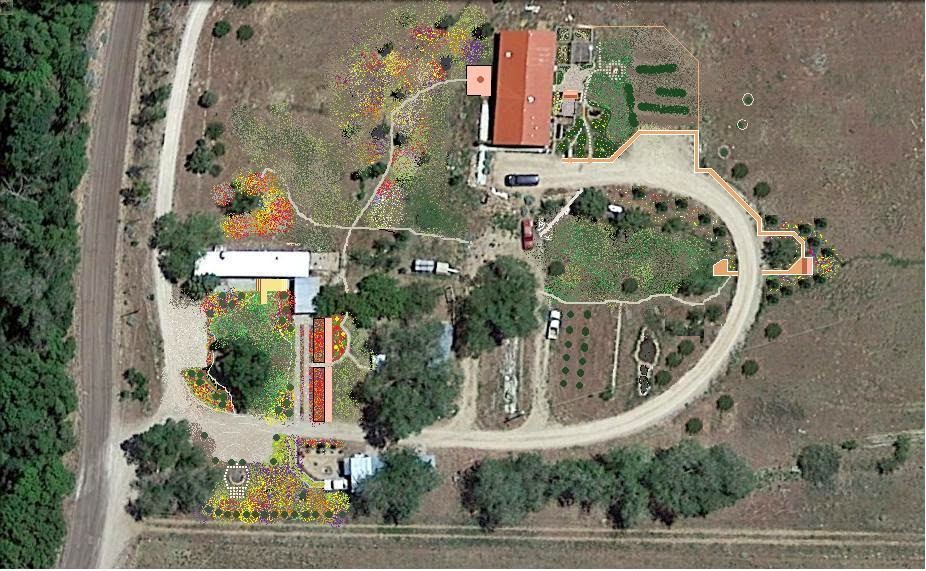
Dry Creek from Above: Phase 1--The Five-Year Master Plan (Garden Design, Water-wise Landscaping, Hugelkultur)


Picture this:  You are heading up a narrow, paved road towards the mountains; on the left is a thick wall of oak and maple clinging to the shaded slopes of a canyon that drops off to the cottonwood bottoms below.  In front, and to the right, is a farm with big, old elms, a trailer house, various out buildings.  But as you turn onto the gravel lane, a world of color opens up. The typical western barnyard blossoms into a playful mix of Tuscany, 1940's and 50's Americana, the psychedelic 60's, and a little bit of Mexico.  This is Dry Creek Farm--where the whimsical is woven with the past and nature to create an interplay of texture, color and spaces.  

Okay, so I dream.  But they are not totally idle dreams.  And I'm not sure they are unattainable.  I have accomplished quite a bit in two years.   


First, an overview of the western 30 acres of Dry Creek.  The photo above shows the portion of the property nearest town.  The top of the photo faces west.  The big, square pond is the county irrigation pond.  The dirt road near the top that goes from the black top to the county pond is the border of the property.  The red-roofed house is ours.  The small pond near the center is where we swim.  The thick band of trees near the bottom of the photo is Dry Creek Canyon, an oak and maple forest watered by a seasonal creek.  Mom and Lloyd's house is at the end of the long gravel road, near the pond.  The pond to the left is actually not on our property, but we have access to it, due to the fact we share irrigation.  When there is water (March through early July), there's lots of irrigation, but sometime between July 4 and July 15th, everything dries up.  This makes our property great for growing trees, but not much else--at least not with traditional farming techniques.  We once grew alfalfa, but we were only able to harvest two crops per year.


Above is a picture of the portion of our land that I consider my yard.  The top of the picture faces east.  It is here, I'll begin developing the gardens.  The thick band of trees left of the road is Chalk Creek Canyon.  When I was a child, the creek here flowed year-around.  However, the county now sucks it dry up-stream most of the year and sends the water to the county irrigation pond.  So here, Chalk Creek has become a seasonal stream, like Dry Creek.  

Just right of the road is the trailer, which for years was our summer home.  To the right of that is the "pig shed," the last of the farm that existed when I was a child.  It is hard to see, being under a canopy of trees.  Across the gravel road, near the bottom of the picture, is the "Blue Door Bar," an old shed we converted into a TV room when we spent our summers in the trailer.  To the east of the trailer and north of the house are the 25 oaks Lloyd and I planted as bare-root saplings back in 1996.  It's taken a long time, but they've become fairly impressive, and will really be amazing in another 10 years.  


Above is the master plan for the gardens at Dry Creek.  After you enter past the elms at the bottom left-hand corner, there will be a choice of two parking areas, one by the trailer, and one near the western fence line.  Generally, I'm against lawn because of the water it uses. However, as the lawn in front of the trailer is part of the land's history, I'd like to keep part of it, at least for a while.  Yet, it is very difficult to keep it green, especially around the edges. Therefore, I'd like to cut it back in an irregular shape and create metaphorical pond.  I'll put boulders around the edge, along with alpine flowers and aspen.  I'm also going to extend the trailer porch out into the green of the lawn as a dock and tie a canoe to it.

Because lawns are well-watered, Aspen eventually send out succors, and if not mowed regularly, take over.  Not only am I fine with that, it is part of the plan.  As much water as aspen need, lawn needs a whole lot more.  Last summer, I watered my lawn on average of three times a week and for most of the summer, it was a pale, dusty green with yellow brown around the edges.  In contrast, I watered my aspen groves on average, once every two weeks.  And I'd rather have an aspen forest than a lawn anyway.  The lawn-lake just creates a fun metaphor to enjoy until the aspen take over.

West of the other planned parking lot is an old cattle trough, which I'll turn into a fountain.  There will be a formal stepping stone path around it, and a small patio behind it with a wrought iron cafe table and two chairs.   Surrounding this will be a Tuscan-styled garden, framed at the back with skyrocket juniper.  I'll also place skyrocket juniper around the parking lots, that'll frame the garden like the scattered ruins of Roman columns.   For vegetation, I'll plant drought resistant plants and flowers, like lavender, black-eyed Susans and sunflowers.  As this garden is a ways from the house, it would be best if it can look healthy with only one watering per week. Using the soil building methods of permaculture, this should not be that hard to accomplish.

Next to the Tuscan-styled garden is the existing rose-garden and the old Mercedes I painted to go with the Blue Door Bar.  Here, I want to plant a dirt road in front of it.  I did say that right.  I'll use flowers to create the illusion of a dirt road with the two tire tracks and with a grass center. Only it will be created completely out of flowers.


An old Mercedes my in-laws were nice enough to haul 242 miles on the back of a trailer
so that I could decorate my property with it.  I added the yellow.
The Blue Door Bar, an old shed we converted into a family TV room and hang out.

To the south of the trailer, in the "square," which is framed by three big, old apricot trees to the east and the pig shed to the south, will be four whimsical specialty gardens, which Marci has made me promise to keep secret until they're completed.  She believes the gardens are unique enough someone might steal the idea.  She might be right,  so I'll share those when they're complete.  


The winding trail that begins in the Specialty Gardens will connect the gardens at the front of the trailer with the oak forest Lloyd and I planted back in 1996 and Marci's cutting flower garden.  As we enjoyed Marci's cutting flower garden so much, we decided we will expand it into the the oaks.  So, we'll have cosmos, bachelor's buttons, zinnias, wildflowers and sun flowers growing in a among the trees. 15 minutes of water per day was more than enough to keep them thriving, and that was without much mulching or building up of top soil.  Using chop and drop methods, I'm sure it won't take too many years before watering can be reduced to 15 minutes, three times a week.  


Marci's Cutting-Flower Garden 2014 with the Oaks and House Behind

Shortly after crossing through the old apricot trees and past the aspen grove, there will be another trail heading south, which heads into the big "island" which is formed by our driveway. This is part of the old barnyard, and the soil is very good here.   On the left side of the trail will be a large park area covered in buffalo grass.  This is so the grand kids will have a place to kick a ball around or play tag.  To the right will be the fruit orchard, a small pond and a pine and aspen forest.  The trail will end at wooden deck that looks over a small winding irrigation stream.


Park Area for the grandchildren.  Currently it is seasonal cheatgrass that I mow.
I'll plant buffalo grass here because it doesn't take too much water, and yet stays soft.


The small reflection pond.  It needs to be lined properly.

The deck will be connected to the driveway by a boardwalk, which will then will continue on the other side of the road and lead to a shaded wildlife overlook platform surrounded by aspen and a large Austrian pine.  There is also an irrigation ditch here to overlook.

The Wildlife Overlook Platform will be designed
to match this grill pad, unifying the garden.

The boardwalk will then continue around the opposite side of the pine, where it will follow the road around to another parking area and our backyard, where our vegetable garden is. Featured here will be three large hugelkultur mounds.  


I hope the above plan gives some idea of what the finished garden will look like.  I believe it will be stunningly beautiful, and more importantly, for its size, will only use moderate amounts of water--far less water than the alfalfa field did.


Sunday, February 15, 2015

Creating a Tuscan Garden Path & Outdoor Dining Area in the Great Basin: Part I--Winter Dreaming

Although it is technically still winter, our unusually warm weather has sent me into garden dreams.  Still suffering from an infection, I can't actually get outside to work.  But I can shop for ideas and scheme.  Here is my plan for creating a little bit of Tuscany in my own backyard in spite of the obvious climate differences.
 
Existing Pond, Path & Grill Pad

1.  The Site

There is a narrow gravel path that runs from the driveway, past a small pond, to a series of three outdoor rooms partially enclosed and separated by three structures--a hanging bucket garden, a grill pad (above) and a pergola.  The three outdoor rooms are well defined and work well together as three interlocking spaces.  The pond also ties in nicely and reflects the grill pad.  But, between the driveway and the pond, planting seems unrelated and once the spring grass dies back, the pathway lacks definition.

2.  Tuscan Inspiration

Besides being my favorite garden style, a Tuscan style garden is perfect for Dry Creek because we only receive 12 to 15 inches of rain annually.  Although we can't grow many types of Mediterranean plants here because of our cold winters, I believe I can find enough substitute plants to make it work.  In particular, the natural rabbit brush can provide the soft grays of rosemary.


3. Existing Tuscan-Like Features

On top of that, I already have a few old-west features, such as my hanging bucket garden and pergola that give a nod towards traditional Tuscan garden structures.  I don't want to so much recreate a Tuscan garden as use a Tuscan garden as a familiar reference point and transform it with references to the American west.  I believe there are enough similarities between Tuscany and the West that I can blend the two into an effective hybrid garden.

Existing hanging bucket garden.  After this picture was taken,
my grape vine took off and softened the structure.
 
Pergola with grape vine beginning its way up nearest post. 
Vegetable garden wraps around two sides.
 

4.  Lessons Learned from an English Cottage Garden Pathway


4a.  Use of Pots

Although the above video models creating a traditional English cottage garden, I found inspiration in the even spacing of ceramic pots along the path to provide pattern and structure to what is otherwise an informal, winding path.  I will place ceramic pots along the south edge of my path, alternating plantings of skyrocket juniper and red geranium in them.  On the north border of the path, I will place lamp posts with lights over the pathway and hanging baskets both sides.  This will continue the verticality of the garden structures out towards the driveway.

4b.  Shrubbery in Patterns

Although you can't grow Italian Cypress here, skyrocket juniper are a good substitute.  Not only will they enhance the verticality of the garden structures and lamp posts, they will provide a common Tuscan reference point to build the rest of the garden around.


5.  Stay True to Your Site while Playing with the Exotic

 
Although I have never been to Tuscany, and most likely never will be able to afford such a trip, I don't think it will be hard to create a little nod towards that distant land in my own backyard while still honestly acknowledging the western structures, plants and landscape that exist here.
 
To me, that is what gardening is all about:  work with the topography and history of your site while playing with it until you create something that both respects the past and nods towards the exotic or new.


Sunday, February 1, 2015

Lessons in Sustainable Living from the Grapes of Wrath: A Reading and Writing Journal (Entry 2: On Transport Trucks, Patsy Cline, Turtles, Weeds, Permaculture, Sepp Holzer, the Dalai Lama and Worms)

It's only been a day since the last storm and the haze is back.  It use to take at least a week, and then a few days.  Even with the oak and maple along the canyon slope, the cottonwood rising from the stony creek bed, and the wall of loose stone and ceder on the ridge beyond, it's hard to be here fully in the moment. Quite simply, winter moments here are no longer the same.  For now, spring and fall are still crisp, but pollution is eroding away our days, our weeks, our months, our seasons.  Maybe some don't notice.  Maybe some don't care. But to me the sky is everything: my connection to light, and through that light, my connection to the world around me.  It's not just about global warming; it's not just about public health.  It's about being in a world that sheds light on the sacred.  Pollution dims our connection with creation.

This morning I read Chapter 2 and 3 of The Grapes of Wrath.  Chapter 2 doesn't necessarily provide any lessons in sustainable living, but the writing is spot-on and made me long for simpler times.  Obviously, not better times.  I've tried not to be pulled into ubi sunt, or the unnatural glow of the past, where we long for a rose-colored yesteryear.  I'm not Ronald Reagan.  I'm aware the good ol' days included lynching and constant insinuation that your wife and daughters were inferior.  But, there was a directness to living that has vanished even since I was a child, and that had already faded compared to my parents' generation. Steinbeck captures so well that period when people were fewer and even strangers were more connected:

A huge transport truck stood in front of the little roadside restaurant.  The vertical exhaust pipe muttering softly, and an almost invisible haze of steel blue smoke hovered over its end...  Inside the screened restaurant a radio played, quiet dance music turned low the way it is when no one is listening.  A small outlet fan turned silently in its circular hole over the entrance, and flies buzzed excitedly about the doors and windows, butting the screens.  Inside, one man, the truck driver, sat on a stool and rested his elbows on the counter and looked over his coffee at the lean and lonely waitress...

When I lived in Dallas, I longed for such scenes.  As a student at a nearby university, I'd drive home each weekend on the back road, the old highway, instead of the interstate, because it was lined with barely surviving cafes from better days--left overs from the forties and fifties.  I longed for that slower life, the one I'd grown up with.  I'd take great road trips in search of an America lost, an America I was almost too young to know, but not quite.

Once I found it in Terlinqua, Texas with a girlfriend from Germany.  We sat in a small cafe and stared out at the white stone desert listening to Patsy Cline over a small radio while drinking Blue Sky soda and I thought I was in heaven.  I could almost see a bright red truck pull up with OKLAHOMA CITY TRANSPORT COMPANY in twelve-inch letters on the side.

True, the time periods did't line up--Grapes of Wrath predating Patsy Cline--but for me, it was close enough.  Ceiling fans whirled overhead.  Patsy sang "I Fall to Pieces" and my beautiful biologist friend went on about symbiotic relationships, while I looked out the window into a distant time.


Chapter 3, my favorite one of the book, does provide a couple of lessons in Sustainable living.  It's the turtle chapter that serves as a metaphor for the struggle the Joad family will endure.  As Steinbeck was good friends with marine biologist Ed Ricketts, he had a deep understanding of nature, which bubbles up in his writing:

THE CONCRETE HIGHWAY was edged with a mat of tangled, broken, dry grass, and the grass heads were heavy with oat beards to catch on a dog’s coat, and foxtails to tangle in a horse’s fetlocks, and clover burrs to fasten in sheep’s wool; sleeping life waiting to be spread and dispersed, every seed armed with an appliance of dispersal, twisting darts and parachutes for the wind, little spears and balls of tiny thorns, and all waiting for animals and for the wind, for a man’s trouser cuff or the hem of a woman’s skirt, all passive but armed with appliances of activity, still, but each possessed of the anlage of movement.

The first sustainable living lesson from this chapter is that nature is designed to take care of itself.  In many ways, industrial farming treats nature as the enemy of agriculture.  Weeds are wicked.  They are plowed up. Bare soil is the birth of life.  But it isn't.  Steinbeck seemed to sense this.  Foxtails, unpleasant, weedy and thorny shit, are the pioneers of life.  After the turtle finally crosses the road, he inadvertently plants the seeds to repair the soil disturbed by the drought and wind:

The wild oat head fell out and three of the spearhead seeds stuck in the ground. And as the turtle crawled on down the embankment, its shell dragged dirt over the seeds. The turtle entered a dust road and jerked itself along, drawing a wavy shallow trench in the dust with its shell. The old humorous eyes looked ahead, and the horny beak opened a little. His yellow toe nails slipped a fraction in the dust.

Permaculture, like Steinbeck, recognizes the weed as the first cultivator of life. Rather than being the devil, the weed is the heart and soul of Eden.  One starts ones garden the way nature does--with weeds--and then, by studying the natural processes, works with nature rather than against to achieve a desired outcome.  


The second lesson we learn from Chapter 3 is a Buddhist principle, which is the practice of loving kindness.  It's slightly different than the Christian principle of brotherhood, in that it recognizes that every living thing has its own purpose, its own journey to complete.  Instead of being thy brother's keeper, one steps lightly, so as not to cause undo harm to life around you, which is demonstrated by the two drivers in the chapter:

Now the going was easy, and all the legs worked, and the shell boosted along, waggling from side to side. A sedan driven by a forty-year-old woman approached. She saw the turtle and swung to the right, off the highway, the wheels screamed and a cloud of dust boiled up. Two wheels lifted for a moment and then settled. The car skidded back onto the road, and went on, but more slowly. The turtle had jerked into its shell, but now it hurried on, for the highway was burning hot.

And now a light truck approached, and as it came near, the driver saw the turtle and swerved to hit it. His front wheel struck the edge of the shell, flipped the turtle like a tiddly-wink, spun it like a coin, and rolled it off the highway. The truck went back to its course along the right side. Lying on its back, the turtle was tight in its shell for a long time.


I believe that both Christ and the Buddha had it right.  With people, there are times, we are our brother's keepers, and must offer others the grace offered us when we lose our way.  With nature, we must at least practice loving kindness--harming no life unnecessarily, to allow each creature to fulfill the measure of its creation.

With this thought process, the grasshopper becomes as meaningful to the garden as the hummingbird or butterfly.  The workings of man develop habitat rather than destroy it.

I remember one beautiful afternoon I spent watching a wasp drag a dead tarantula from one end of my garden to the other.  I was amazed at how quick he was, how diligent, and the obstacles he overcame.  At the borders of my pond, he encountered what to him were enormous boulders.  I was sure his home was there in a crevice between two rocks, and was surprised when he toiled on.

It gave me strength to toil on with an infection I had experienced for months.  It brought peace.  It is in these small noticings, these small acts of loving kindness, these steps back with humility, observing rather than participating, that we find the true measure and purpose of our creation.  If you kill the little birds (or the wasp), you can't learn from the the little birds (or the wasp).  You're aligned with the wrong energy.    

My favorite scene in Seven Years of Tibet is where Heinrich is asked to save the worms when building a movie theater for the young Dalai Lama.  Whether that really happened or not isn't significant.  It's taking the time to do that sort of thing that would lead to a kinder, more sustainable civilization.


Wednesday, January 28, 2015

Lessons in Sustainable Living from the Grapes of Wrath: A Reading and Writing Journal (Entry 1: This Valley is Me)


This valley is me, and I am this valley.  Lately, it hasn't been doing so well and neither have I.  Skies have been gritty, a haze of humidity and grime smudging the horizon, rust-tinted snowy peaks rising out of the smoke.  Inversion, they call it.  They treat it as a natural phenomenon, but my history here goes back far too long to buy that.  Skies once were clear, and it was not unusual to be able to see peaks 75 miles away. Now the haze hangs around for days, even weeks, between storms.  It's like living along the Wasatch Front without the city.  Spill over--that's what it is--like the rust colored air that hangs over the Mojave because of Los Angeles.

Scripture describe such times:  

And he opened the bottomless pit; and there arose a smoke out of the pit, as the smoke of a great furnace; and the sun and the air were darkened by reason of the smoke of the pit.  (Revelation 9:2)

Whether this is smoke of biblical proportions or not doesn't matter as much to me as that it hangs around and distorts views I once saw so clearly.  Regardless of whether or not it is a sign of the second coming, it is a sign of sickness--an environment crying out for redemption, much like the landscape recorded in Steinbeck's Grapes of Wrath:

A gentle wind followed the rain clouds, driving them on northward, a wind that softly clashed the drying corn. A day went by and the wind increased, steady, unbroken by gusts. The dust from the roads fluffed up and spread out and fell on the weeds beside the fields, and fell into the fields a little way. Now the wind grew strong and hard and it worked at the rain crust in the corn fields. Little by little the sky was darkened by the mixing dust, and the wind felt over the earth, loosened the dust, and carried it away. The wind grew stronger. The rain crust broke and the dust lifted up out of the fields and drove gray plumes into the air like sluggish smoke. The corn threshed the wind and made a dry, rushing sound. The finest dust did not settle back to earth now, but disappeared into the darkening sky.

Like Exodus, the Grapes of Wrath is an epic--of loss, of wandering, of survival,and of dignity.  I believe it is also a blueprint for sustainable living, and in this series of posts, I wish to explore the lessons it teaches in sustainability.  Not only is it a masterpiece of literature, it is a field guide for a better way of life.