Saturday, August 25, 2012

Gardens of Accommodation: Heinrick Harrer, the Dalai Lama, Seven Years in Tibet, worms, toads, and Jonathan Livingston Chicken

Tonight, I'd planned on writing about an all-day event that I attended, a communal building of an outdoor oven for a member of my brother's permaculture group, an occasion akin to the barn-raising scene in the movie, Witness. 

Very moving.  But, as poet Naomi Shihab Nye explains, sometimes you want to go to church, but your writing takes you to the dog races instead.

Over the years, I've learned to follow my writing, rather than direct it.  And tonight, eating dinner out by the garden, watching thunderheads build while the wind kicked up and sent the pergola lights swaying, I felt an impulse to post instead about gardens of accommodation.

The pergola at the garden at Dry Creek at night


I'm so new to the sustainable-living lifestyle, I'm hesitant to claim authority about anything having to do with gardens, pastures or farm animals. Yet my garden, for its size, has been incredibly successful, and I purchased zero commercial fertilizers and used zero pesticides along the way.  In fact, from the garden's very inception, I've went out of my way to accommodate nature rather than control it.  Perhaps, that has brought good karma.  Anyway, I'll choose to believe that until life proves otherwise.

My favorite scene in the movie Seven Years in Tibet is when Brad Pitt's character, Heinrick  Harrer, complains to the young Dalai Lama that he can't proceed building the requested movie theater because the workers refuse to kill worms.

The Dalai Lama explains why all life is sacred to Tibetans and then says, "You cannot ask a devout people to disregard holy teaching."

Heinrick Harrer smiles in disbelief, "I'm sorry, but we can't possibly rescue all the worms if you want the theater finished in this lifetime."

"You have a clever mind," responds the Dalai Lama.  "Think of a solution and in the meantime explain to me what is an elevator."

The next scene is of monks gently sifting dirt from worms dug out of the foundation trench and then carefully covering the worms up with dirt in their new home.

I found myself in a similar position when I started filling in a garden bed by our back steps and my youngest son, Everest, protested, "but, Dad, remember that's where our toad lives."

Remembering the movie, I decided that although I needed that garden space I would not bury the our toad-friend under the stairs.  Therefore, Everest and I used river stones to build a series of stepped-back retaining walls that provided stairs to his house under our back porch.  While we were at it, we also decided to save the rabbit brush that had grown wild near by.

Because of our extra work, we've enjoyed many nights of watching our toad catch grass hoppers in the garden under the swaying lights.


The next accommodation I had to make is for our youngest chicken, Blackie, who I quickly nicknamed Jonathan Livingston Chicken for a couple of reasons:  first, because she's a loner who was persecuted by the flock as youngster; second, because for a chicken, she can really fly.  Our summer coup is a converted dog kennel which is over six-feet high.  Although, I put a roof over most of it for shade, I left openings as part of the Japanese-modernism design I desired.  It worked great, except for one problem:  one night, Blackie decided it would be nicer to roost alone up under the great spiraling Milky Way, rather than down in the cage with rest of the flock.

That would have been fine if we didn't have owls, hawks and eagles, not to mention raccoons.
Now, I could have easily strung chicken wire across the openings in the cage to keep Blackie in her place.  But, I thought of Jonathan Livingston Seagull, my favorite movie as a child, and one of my favorite books now:


What he had once hoped for the Flock, he now gained for himself alone; he learned to fly, and he was not sorry for the price he paid.

I would not keep Blackie, my Jonathan Livingston Chicken, from flying higher than any chicken has flown.   So, I spent two very long, hot days building a second story to my coup, an open-air screened room, so that she can roost up there under the grand sweep of the Milky Way, away from the flock, and still be safe at the same time.

Sky Nest added to the chicken coup for Blackie
Sky Nest (detail) addition for Blackie
And at some level, I think she knows that I went out of my way to accommodate her, because I've never gotten around to filling in the other holes in the roof, and I know she could fly out if she really wanted to.  But instead, each night she flies only into the penthouse I made her, happy enough to be high up under the grand firmament spiraling overhead.

Perhaps I'm just some wacko post-hippie, but not only do I believe that all animals from worms to whales have their own individual (not just as a species) spirit, intelligence and will, I also believe that by accommodating these independent wills the best we can, we gain grace that blesses our lives in unexpected ways--a garden that yields more than it should or a loyal chicken who follows you around, hops on your lap and stays--not because she has to, but because she wants to.


Saturday, August 18, 2012

We Make Really Good Tomato Jam while the Boys Are at School

Grape vines ready to harvest at Dry Creek


The sun has moved south; the days have shortened; school has started.  We turn in job applications and wait for calls.  While we wait, we listen to music--John Lennon, Bob Dylan, Paulo Nutini.  And while we listen, we read--Country Gardens, Hobby Farm Home, P.D. James, The Murder Room and Gardening at the Dragon's Gate by Wendy Johnson.  We live off the last of last years wages and take long showers together.  It feels like when we were newlyweds--lots of dreams, some hope, but nothing is for certain, so we cling to each other. 

We harvest the garden and feed the chickens.  We make pickles and jam--really good jam.  Tomato jam, the recipe of which we'll share with our readers.

Marci feeds the chickens

Our first batch of bread and butter pickles


And for now, everything we do, we do together.  It won't last.  It can't last, but while it does, we'll enjoy the last of summer before Eden freezes over.

Marci's Really Good Tomato Jam


Overall, we followed the recipe for plum jam that is in the box of Pectin, replacing the plums with tomatoes and adding spices.  Marci wasn't satisfied with the jam because it didn't taste like her great-grandmother's.  However, two households went through a jar each in a couple of days and everyone raved about how good it was.  Enjoy and post comments to help us convince Marci that this is Really Good Tomato Jam, so that she can move on. 

Half done with my job


Ingredients:


5 3/4 cups of chopped tomatoes (not peeled).
1/4 cup of lemon-lime juice (1 lemon, 2 limes)
1/2 tsp. of cinnamon
4 whole cloves
1 pkg. of Pectin
8 1/2 cups of sugar

5 3/4 cups of chopped tomatoes--yum!

Directions:


1.  Bring tomatoes, lemon-lime juice, cinnamon, cloves and Pectin to a full rolling boil.
2.  Quickly add all of the sugar.
3.  Bring back to a boil and cook for four minutes, stirring constantly.
4.  Remove from heat and ladle into prepared jars.
5.  Process for 20 minutes.

Wednesday, August 8, 2012

First Connection: Brandon Flowers and the Killers

Late afternoon, maybe February, sunlight intense on the cliffs above Lukachukai.  I top the pass between Chinle and Tsaile, the pinion valley below green-gold. Patches of snow littered with pinion needles hide in the shadows as I race by this high, dry forest.  I'm listening to a Killers CD that I bought as a Christmas present for Marci.  Neither of us has really listened to it, but she likes the single, "Mr. Brightside".

Same day--just a few minutes later, in my driveway:  I'm in the van and I won't get out.  This song is different.  There's something so open, so vulnerable, so rebellious.   The lead-singer keeps repeating...

I got soul, but I'm not a soldier

Lyrics don't seem special, and yet something feels familiar.  I replay it, listen closer to the words.

When there's nowhere else to run
Is there room for one more son
One more son
If you can hold on
If you can hold on, hold on
I want to stand up, I want to let go
You know, you know - no you don't, you don't
I want to shine on in the hearts of men
I want a meaning from the back of my broken hand

Still, nothing, at least not in the lyrics, that seems would grab me.  But something does.  Especially during the refrain,

I got soul, but I'm not a soldier


Then, strangely hymn-lines come to mind--

Put your shoulder to the wheel; push along,
Do your duty with a heart full of song,
We all have work; let no one shirk.
Put your shoulder to the wheel.

and...

Onward, Christian soldiers!
Marching as to war,
With the cross of Jesus
Going on before.

What the heck, this is a retro-punk group, with chunks of the Cure, the Fixx, U2, and the Police buried not-so-subtly below the main text of the melody.  Why on earth are Mormon hymns coming to mind?

So, I replay it, and replay it.  Of course, I don't get why.

Yeah, you know you got to help me out
Yeah, oh don't you put me on the backburner
You know you got to help me out
You're gonna bring yourself down
Yeah, oh don't you put me on the backburner
Yeah, you're gonna bring yourself down

Over and again, last call for sin
While everyone's lost, the battle is won
With all these things that I've done
All these things that I've done
If you can hold on
If you can hold on

Fast-forward a few months, and we're at the house in Page (I think), visiting Marci's parents.  We're all around the computer and Tyler tells us Brandon Flowers, the lead singer of the Killers,  is a Mormon.  I don't believe him.  How can I with the lyrics of "Mr. Brightside"?  His uncle Shane backs him up. 

"They say Alice Cooper grew up a Mormon," I protest.  "And that's false.  Why believe this?"

Later, I do some research. Sure enough Brandon Flowers grew up in Nephi, Utah, and is Mormon.  The Killers are based in Las Vegas where Flowers moved as a teen.  Early on the band was asked to relocate in LA, but Flowers refused to leave his adopted home. 

Flowers, like myself, then, grew up in two very different worlds.  Small town Utah and Vegas.  I grew up in small town Utah and Reno. 

With some context, I think I now understand "All These Things I've done."  "I got soul, but I'm not a soldier / I got soul, but I'm not a soldier" is Brandon letting his parents know that although he feels the spirit of the law, he can't live it.  He's got soul (he feels the spirit), but he's not a soldier (he's not going to be a typical Mormon, not part of the united army of belief).  In other words, he's leaving the flock.

Although many other themes, like Vegas, influence Flowers songwriting, his Mormon upbringing continues to seep through.  He's caught between two worlds, Utah and Nevada--neighboring states, worlds apart culturally, although both were settled early on by Mormons.  Like Flowers, I've been caught in a crossfire between heaven and hell.  And I think, like Flowers, I had a hard time deciding which was hell--small town Mormon Utah or the bright light, big Sodom and Gomorrah.  And of course, I also couldn't decide which was heaven.  Even though "Crossfire" is clearly about typical struggles in marriage, it extends, I think, to Flowers wavering between his religious upbringing and his new found freedom in the ways of the world.  That probably is also a source of the marriage tension discussed in the song.


"Human" written earlier than "Crossfire" directly demonstrates his mixed feelings about religion.  He both wants to be part of it, and at the same time break away from it:

And sometimes I get nervous
When I see an open door
Close your eyes
Clear your heart...
Cut the cord


The doors to the world have opened for him; he's got the chance to "cut the cord."  But he can't.  Why?

And I'm on my knees
Looking for the answer
Are we human?
Or are we dancers?


Most lyric sites record the lyrics this way, and they work.  But if you listen to the song, Flowers never puts an "s" at the end.  So, some sites print the lyrics this way--

And I'm on my knees
Looking for the answer
Are we human?
Or are we dancer?


--which are not only grammatically incorrect, but don't have any clear meaning.  Here's what I think Flowers is singing:

And I'm on my knees
Looking for the answer
Are we human?
Or are we denser?


In other words, he's on his knees, pleading with the Lord for an answer to his question, which is, "Are we only human (simply a product of evolution) or are we denser? (in other words, do we carry a spirit within us and have a divine purpose?)

This time, even after his prayer, Flowers decides to cut the chord:

And so long to devotion
You taught me everything I know
Wave goodbye
Wish me well..
You've gotta let me go


It sounds like he's leaving organized religion behind him.  However, he's not angry; he knows his religious upbringing has made him who he is:  "You taught me everything I know."  But he wants to be free between the crossfire of heaven and hell, so this time he chooses to leave.

For much of my life I felt the same:  Mormonism made me who I am, and it was good, but I want more. I incorrectly believed the church limited my artistic, intellectual and spiritual growth.  I now know it's quite the opposite:  I can only achieve my artistic, intellectual and spiritual potential through the church.  It's who I am. 

Based on a recent interview, it sounds as if Flowers has come to the same personal realization.  But, of course, testimony is a day to day affair, so he could again decide to cut the chord.  Whether he does or not, Mormonism will always be an influence on the Killers.  Mormonism is now a major world religion, and as such, more and more artists, writers and musicians will bring that herritage with them to the arts community.  It is time for critics to take Mormonism seriously as an influence on both American and world culture.

Mormons.  We are.


Friday, August 3, 2012

What do Chekhov, Issa, Basho, Duane Niatum, Natalie Goldberg and Italo Calvino have to do with Mormonism?

You're a writer who loves these big, tough songs that pierce your heart and make you feel alive all over again.  You believe in literature with a soul.  You believe in the book that makes you think, that makes you feel as though you've been somewhere and experienced something, that you're a different person for having read it.  Writing to entertain doesn't matter to you.  Writing to impress others with your cleverness or your hoped-for-brilliance doesn't matter as much as it once did.  Your desire is like Chekhov's who spoke of describing a situation so truthfully that the reader can no longer avoid it.  Or, in your own words, to wrangle with the tough places in yourself and your subject.  Those things matter to you. 


Thus opens "Writing:  An Act of Responsibility" by Phyllis Barber, which serves as the introduction to The Best of Mormonism 2009 as well as a personal reflection by the author on the role of contemporary Mormon writers in Literature.  As is clear from the opening paragraph, this essay, like the entire anthology, holds its own ground.  So, one might ask, why even publish an anthology of Mormon writers?  If they truly are on par with their intellectual peers across the nation, why not read their work in Black Warrior Review, Iowa Review, Puerto del Sol, New Yorker, etc.?  Obviously, one reason might be the same reason I assume Duane Niatum put together Harper's Anthology of 20th Century Native American Literature in 1988.  Prejudice.  Lack of market.  Unequal access.  History distorted by other voices.  The desire to be taken seriously without abandoning your culture.

But, I think there is another reason, which is indicated by the fact that this personal reflection is written in second-person, not first.  Very different from say Natalie Goldberg, whose personal reflections are always wonderfully personal, wonderfully informal, wonderfully irreverent.  That second person is there for two reasons:  First, as Mormon artists we are unsure of ourselves in the outside world.  Not afraid that we aren't good enough writers, but afraid that if we write about what matters to us most, our religion, we won't be taken seriously by non-Mormons.  So we distance ourselves, seek safety in the second or third person. 

The truth is we don't fully believe that we can "describe a situation so truthfully that the reader can no longer avoid it."  Not that we'll fail as writers, but that the world will fail as readers--that the mere mention of our religion will kill any chances of being heard.  Believe me, this is a valid fear.  If you're still tuned in, you're more enlightened than most. Thank you.

Barber doesn't openly discuss this fear.  Most Mormons won't.  When it comes to facing prejudice, Mormons have largely turned the other cheek.  It's what we're taught. Confrontation kills the spirit.  The Holy Ghost and argument can't coexist.  It's pretty difficult to get a well-brought-up Mormon to Bible bash.  The unintended effect is a lot of us spend much of life invisible.  Not that people don't know we're Mormon.  We're pretty open about that.  Not that people don't know we're writers; we're pretty open about that.  But we're afraid to be Mormon writers.  We want our intellectual and artistic life to be separate from our spiritual life.  Absurd, of course.   If poetry is bread, and I'm Mormon, it's ridiculous that I should try to write only secular verse.  And yet we do.  That is the deadliest effect of prejudice.   It makes the victims question themselves.  I am is no longer I amI am is either what you want me to be or I am is a reaction against what you want me to be.  Either way, I am no longer exists.

Barber does talk extensively about the other fear that plagues Mormon writers.  Will we be open enough, or will our religion cloud our vision?  In other words, will we be as prejudice towards others as others are towards us?  Will we get on our high horse? 

In reflecting on this, Barber uses politics as a venue to discuss the role of personal belief in literature, paraphrasing Italo Calvino's rules as a start:

1) Literature should never be used for a single cause--i.e., Maoist theory is the only valid subject for Chinese writers.

2) Literature should never be viewed "as an assortment of eternal human sentiments".  It is not the job of the writer to write what is already known, but to discover the unknown.

3) Literature is vital when it "gives voice to whatever is without a voice".

4) Literature has the potential to "impose patterns of language, of vision, of imagination, of mental effort and the creation of a model of values that is at the same time aesthetic and ethical".

I believe Calvino's descriptions of the right and wrong mixtures of politics and literature extends perfectly to matters of religion.   I also believe Calvino's descriptions of right and wrong mixtures extends to many of the arts.  I therefore propose to write several small articles about the work of Mormon writers and artists.

The purpose is not to proselytize.  I'll leave converting to the missionaries who have probably already knocked on your door during supper time.  And the purpose is not to build bridges--to find universal values that we share across our distinct cultures.  If you don't like me for who I am, too bad.  I spent the first thirty years hiding who I really am, and I've been done with that for more than a decade.  I AM.

Rather, I want to demonstrate that there is a healthy, vital Mormon arts community out there, and if you're not familiar with it, you're missing out.  Imagine the world without Jewish, Catholic, Buddhist or Islamic art. 

Secondly, Mormon culture is strong enough to ""impose" unique "patterns of language, of vision, of imagination, of mental effort and the creation of a model of values that is at the same time aesthetic and ethical."   Much of Mormon art is uniquely Mormon.  Just as you can't read Issa or Basho without becoming a little bit Buddhist, you can't read or listen to certain Mormon works without becoming a little bit Mormon.

If that scares you, well, you've got a problem.  But, you don't have to deal with it.  Just exit this blog, don't return to it, and your world will remain forever the same.

As for my title, "What do Chekhov, Issa, Basho, Duane Niatum, Natalie Goldberg and Italo Calvino have to do with Mormonism?"

Nothing really, but would you have you typed in "Mormon Writers," "Mormon Artists" or "Phyllis Barber" in your search?  Probably not.  Thus the need for this and many similar posts.
 

Tuesday, July 31, 2012

Wildfire! Bloggers are Jack Kerouac's True Heirs: Remembrances "Written on the Run"

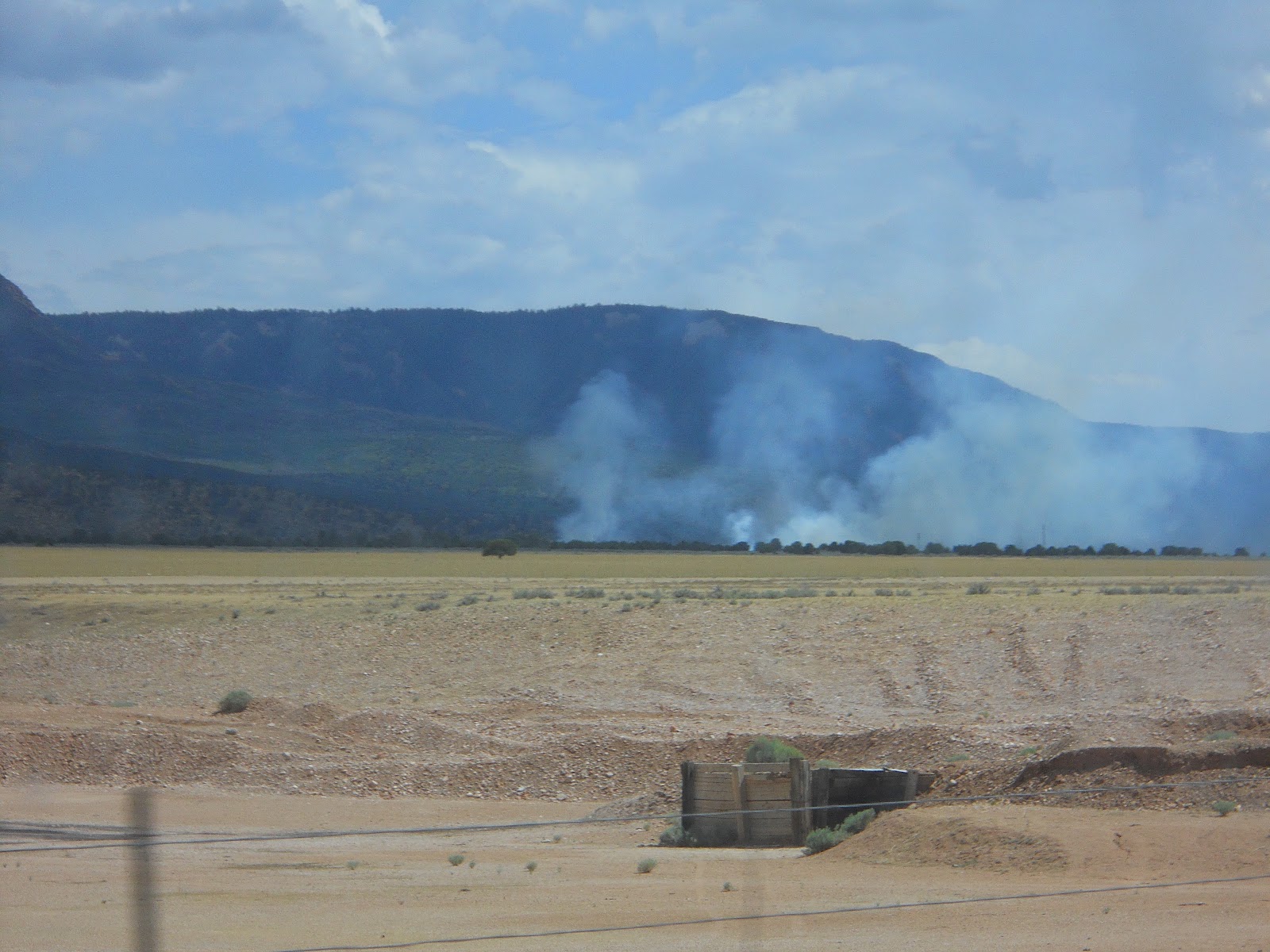
Blogging on the Run: Cedar Fire, July 27, 2012:  Marci and I were in town dropping off videos when we first saw Cedar Hill burning.  I'd been mowing the lawn earlier and saw a flash of light to the north, felt the thunder, followed almost imediately by sirens.  As I didn't see any smoke, I figured they had it out.  Lloyd, Rio and I came back later with the camera.

In describing his lifelong achievement in writing, Jack Kerouac wrote, "My work comprises one vast book like Proust's except that my remembrances are written on the run instead of afterwards in a sick bed" (Introduction to Big Sur).

Life and Death happening between blog posts.  Our second local wilfire this season.

Having less than a dozen published poems to my name and nothing else in print, it may seem a bit presumptuous to compare myself to Kerouac, but when it comes to writing, pompous I am, pompous I be, and pompous I do.  Anyone who knows me, knows that out of necessity I have plenty of humility in other arenas in my life.   Writing is my one and only claim to greatness, which I'll cling to, even after I die. 

Driven by strong winds, the fire quickly spread to the northwest. 

However, I only compare myself to Kerouac because of process.  Writers write.  Quality and rank is determined after death, sometimes hundreds of years after death.   And my affinity with Kerouac is probably also my greatest weakness. I had a professor once tell me, "Everything you write is about yourself; as good as you are, you need break out of the box and write beyond your own insignificance."  He then proceeded to steer me to a novel project that went nowhere.  It could only go nowhere because it wasn't about me.  And like Kerouac, I only write I.  In younger years, that seemed to work well.  Ann Charters writes that Kerouac was "more committed to the act of creating literature out of his life than he was to living it."  Even encumbered with shyness, I lived a Kerouac-like life, which although not necessarily good for the soul, none-the-less was great for the page.  In El Paso, I truly was a Dharma Bum.  Only the void I entered was null, a face-to-face encounter with death without the release of Nirvana.

Wildfire is the new reality of the West.  Our forests will not be able to recover at the rate they are burning.


And so I went home.  There was nothing else to do, but start over.  This time, I decided that I would be more committed to the act of living life and less committed to creating a literature out of it.  I developed a plan to overcome shyness, went back to college, met Marci, who saved me, got my degree, as well as a real career, teaching, which I loved so much that for five years I didn't even write.  Then, slowly, I found a couple of projects that sort of worked for my new life.  The first was a project suggested by my brother, who is an artist.  Nevada's Highway 50 has always had special significance to us, as it was the road of our youth and connected our two homes--our mother's home in rural Utah and our father's home in Reno, Nevada.   We would write an illustrated book together, Highway 50:  Loneliest Road in America to premier at his art show of the same name. 

He was diligent.  So was I, at least for a couple of years.  I wrote frequently in a new format I discovered, which wove together current journal-writing with remembrances of the five-day trip we took together across Nevada's U.S. 50 to kick off the project.  I was even lucky enough to find an audience at Dine College's monthly Night at the Library.  Having an actual audience encouraged me to keep writing.

But then something happened.  We moved.  My format fell apart.  Like this blog-post, the expository explanations of the life-transition killed the text for me.  What made the writing sing--that is was remembrances "written on the run" also killed it.  Some of the leaps we must make in life are significant enough that the text refuses to follow.  The only way to go back and bridge the gaps is with summary, the deadest of all forms of writing.

Recently, I started a novel that weaves together a fictional story of a literature professor discovering the streets and rails of Chicago with a fictionalized true-account of living in my in-laws basement in Page, Arizona and actual journal writing.  But, again, I fear it may suffer the same fate of Highway 50 now that we've moved to Dry Creek.  I hope not, because it feels publishable.

But if it can't make the leap, that's okay.   I think I have finally found my venue.  The blog.  What format could be better for literature "written on the run"?  As, I've shown here, you can even record two stories at once--the text narrative and the pictorial narrative--which don't even have to line up.  Blogging truly is versatile.

I hope this trucker is either a blogger or vlogger.  How many wildfires are unfortunately now part of his runs?


Can I make a living blogging my life?  Can I become a known writer via the blog?  Who knows.  I don't even care.  Here's what I've finally learned.  Live life by a plan.  Write on impulse.  Never confuse the two.  And don't let one rule over the other.  You don't have to starve to keep your art alive, but you do have to stay slightly hungry.  If there's no reaching, there's no art.  And for the artist, if there's no art, there's no life.  We slowly die without that irrational impulse to record life on the run and share it with some unknown audience out there--real or imagined.  That's what drove Chaucer, that's what drove Kerouac, and it's what drives contemporary bloggers, like myself.  So, to steal from Jack, I hope you continue to enjoy "the world of raging action and folly and also gentle sweetness seen through the keyhole of [my] eye" because I'm driven to share that view with you whether you like it or not.


While our second fire of the season was still burning out of control to the north, the third fire of the season (and second in the same day) started to the south of Dry Creek.  Luckily, both were brought under contol that day.  These last two shots were photographed from the same location.  With two fires to fight at once, things could have turned ugly.

Thursday, July 26, 2012

Sustainable Living: Here--Every Vital Place has its Scent.

Front Yard at Dry Creek.  Lloyd and I planted the oaks as seedlings in 1996. 
Large trees in the background are natural, following the canyon slope of Dry Creek Canyon.
It has been cool at Dry Creek since our return--with cloud cover, with rain.  Yesterday, it only reached 86.  Nice.  I sit in the arranged living room that only yesterday morning was so crammed with boxes you could hardly walk.  A cool breeze blows gently in the window.  Jack, our cat, sits on the sill, twitching his nose as he catches wafts of moist air from the canyon.

Living room after Marci arranged it.

Every vital place has its scent.  I loved August afternoons hanging up laundry in Tsaile.  Cool wind would bring the warm scent of summer pine as the monsoon clouds would build along the Lukachukai Mountains.

Here the predominant smell is of creek bottom and cottonwood.  It rises out of the canyon in waves on even the hottest of days.  Walking up to Mom's house is like going for a swim--how currents in the water bring ever changing temperatures.  Even though yesterday was mild, while we were walking up the lane, Marci hit a pocket of hot, humid air and commented on it.

Likewise, on the hottest of days, you'll be walking up the lane and a moist, cool pocket of air will perched on the canyon edge, waiting for you.

I have come to realize these small moments are worth whatever job I might have to take up to put food on the table and remain centered on this land.

Marci turns to look at the rainbow while looking after the chickens.  Autumn, my brother's dog, stays focused on the chickens.

Life, at least for the poet, is about place.  I don't need to be here, but I need to be some place alive with wild sights, smells and textures.  Alaska would probably do as well.  But as this is my home, heritage, it seems more ethical to make it here if I can.

I don't know how to explain this.  It may be something only people who identify with a minority group can understand.  Navajos get it.  A Navajo may have to live, may even enjoy living in Seattle, New York or Phoenix, but to most Navajos the only real home is the reservation.  They may enjoy the malls, the lawns, the restaurants in the big city, but their center is always the hearth at the center of grandma's hogan.

Utah is the Mormon reservation.  Zion.  For some, like me, it is a tainted garden, and we have a love-hate relationship with it.  How could it be otherwise for a liberal living dead center of Republican Land?  Yet, it is still home--the sights, sounds, smells, textures we identify with being.

The garden at Dry Creek--Our summer hearth.

Tuesday, July 17, 2012

Bono & the Big Heat: Drought, Fire, Love and Marriage in the American West

I've been planning to post this poem for sometime, but not necessarily wanting to.  Drought and fire have become the norms of living in the American West.  This year could be 2007 all over.  Once again, we have spent a good chunk of our summer watching fires--both live and on the news.  This is new.  Forest fires were not a regular part of my childhood.  They have and will continue to be part of my children’s.

This is my best poem, which is why I wanted to post it.  But it captures tension in my marriage, which is why I didn’t want to post it.  Marci literally saved my life.  Back in November of 1994 I hit rock bottom for reasons I won’t go into here, reasons I’m not even sure I totally understand, and probably can’t explain.  Anyway, I spent Thanksgiving night 1994 drunk, wandering up and down Mesa Street in El Paso, screaming “I want to die” at the occasional passing car and cursing God for my life.  Somehow I’d become encased in a shell of shyness and couldn’t seem to get out.  I blamed God for my inability to be myself around others, especially women.

I woke up the next morning with this strong impression:  go home.  So, I made plans to move back to Utah after spending 12 crucial teenage and college years away.

Shortly afterward I met Marci, and overall, I’ve been happy ever since.  I have two versions of my life:  one of deep dissatisfaction and anger and one of general satisfaction and deep joy--life before Marci and life after Marci.  She literally rescued me.  But no marriage comes without tension.  This poem records that tension, and that tension is its strength.  However, it’s much easier to share unabashed praises to my wife, and I’ve written many such poems.  Yet, good writing often requires doing the hard thing.  I have no idea if I will ever become known as poet, but if I do, this is one of the poems I want to be known for:


The New West

7/14/07

Cicadas riot outside the window.   Everest on the cot at the foot of our bed sleeps silent.
It is a warm night after an intensely hot day.

Earlier we drove out to investigate the biggest fire in Utah history. 

Over 360,000 acres.  Deep, rutted roads through soft alkali soil.  Neither Lloyd nor I remember these roads this way.  You want us to turn around.  Winding between high brush. 

Finally, first black finger of fire.   The print, really.  Strikingly manicured, smooth as a golf course, black rolling undulations below craggy black basalt cliffs. 

Then a stand of untouched brush and a lone juniper.  “One Tree Hill,” you say  The Joshua Tree.  U2 standing stoic before the shockingly sparse American West, Bono sweating in a white, wife-beater t-shirt.  In different places, that album spoke to us.  The Edge’s fingers clicking the strings like cicadas in the night.  Suddenly searing sounds rip through the atmosphere, bulleting the blue sky.   Bono, a mad preacher, snake charmer, symbol of sex, God, America.  And you give yourself away, and you give… Until, like an Arizona monsoon, the thunderheads rolled on.  Somehow I ended up forty and married. 

At some point we stopped.  Lloyd, the boys, Darth and I hiked up a volcano.  It irritates me that you remain behind.  Love is that way.  I still haven’t found what I’m looking for. 

A spoiled brat I insist you meet me inside myself where it’s impossible.

One hundred and three degrees Fahrenheit.  Heat rises in thick waves off charred grass and heat-polished, volcanic bombs.

The lone, silt covered van sits with you hidden inside, the size of an ant, at the edge of a chalk-white stripe etched across a broad, black valley, two isolated fires still smoldering in the distance.

One wide, like a dust storm.
The other narrow as the funnel of a small tornado.

I can’t live without you.


7/22/07

Sunday, the day of rest. 

I nearly nap on the living room floor after church, dinner and a late afternoon thunder storm.

Cool evening.

I sit at a round table under the swaying colored lights of the patio of the Blue Door Bar,

which we made together, for me,
in memory

of wilder nights and days blurred like smoky dusk following a fire. 

Margarita glasses now filled with milkshakes.

Our boys sit at the black-tiled bar under blinking martini light playing cards with Elvis on the back. 

Lennon is on the t-shirt on the wall in his guerilla suit.

Crickets chirp.

I walk up the lane to visit Mom. 

Deep smell of cool wet woods. 

Afterwards, I grab a flashlight and walk down in the canyon loud with life.  Cicada, cricket.  The night breathes after a short, intense rain.

Tomorrow there will be heat, dust, struggle against drought again.

7/27/07

Cool shade of cottonwood,
Chalk Creek churning,
over worn stone, singing
the same song over thousands of years.

Sunlight on boulders the size of over-stuffed chairs down to the size of ladies purses.

Deep reds,
pale blues,
rounded by the roll of ages.

Turbulent creek-beds during spring run-off.

What if global warming ends the snow-pack,
ends the annual rock toss downstream?

No more high waters cutting into banks,
bringing down trees, piling up crud?
No more silt and shit
beautifully backed up behind log jamb
to fill in with meadow
and cottonwood
and birds singing?

What if the seasons of the west end
and the song of the crashing creeks
goes silent?

What then will be our song?—

You and I colliding
--Indian Mormon and White Agnostic Mormon—

Begetting children here
among these rattlesnakes and song birds?

Will our family go on here
after Dry Creek cuts
through our land dry forever?

© Steve Brown, 2012


Extra:  Click here for Video of U2:  http://www.youtube.com/watch?v=_Ye8GLPUVsM